Attributing an image when the platform and instrument are different
An image credit needs to distinguish the spacecraft that carried an instrument, the instrument that collected the measurements, the organization that supplied the data and the person who made the displayed image. Those roles may belong to different parties. Putting a familiar agency name under a picture does not identify all of them.
Keep two linked records: a concise visual credit beside the image and a data citation that identifies the underlying collection and the subset actually used. Add the processing author when someone has turned the source into a new visualization. This is useful even when a single organization fills several roles.
Below is a metadata-reading exercise using NOAA's real Cloud and Moisture Imagery record. It does not claim that a scene was downloaded or that a satellite image was produced for this article.
Five roles to resolve before writing the credit
“Who made this?” has several possible answers. The operator runs the satellite. The platform is the spacecraft. The instrument makes observations. A data producer processes observations into a named product, and a distributor makes that product available. A visualization author may then select a subset, apply a palette, add labels and export a picture.
This distinction is visible in the source documentation. NOAA's GOES-R overview describes NOAA as the satellite operator and NASA as the development-and-launch partner. The NCEI CMIP record separately identifies ABI, supported GOES platforms, OSPO as the data producer and NCEI as the archive.
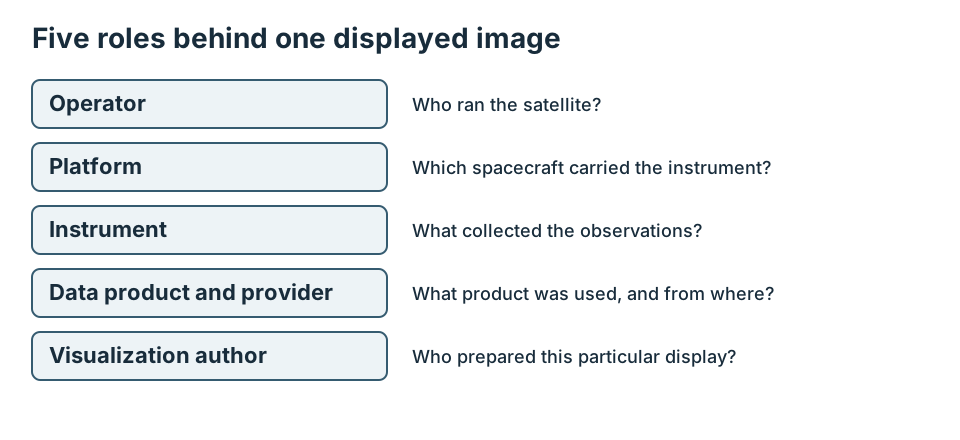
Original role diagram. Connecting the labels does not imply that a new image or a complete credit has been verified.
Work through the NOAA example
Suppose an editor is preparing a credit for a historical GOES-16 ABI visualization. The first job is to confirm that GOES-16 appears in the actual scene's metadata. A collection may cover several spacecraft; its platform list does not identify which one acquired an arbitrary screenshot.
The following decomposition is therefore partly a verified collection reading and partly an explicit scene-level request. Keeping that difference visible is the point of the exercise.
| Role | What can be entered now | What still needs the actual asset |
|---|---|---|
| Operator | NOAA, supported by the GOES-R overview | Confirm that this is the relevant program for the source. |
| Platform | GOES-16 is a platform listed in the CMIP collection | Confirm GOES-16 against the selected file or original image record. |
| Instrument | Advanced Baseline Imager, abbreviated ABI | Match the source product and band to the displayed view. |
| Data product and provider | ABI Level 2 Cloud and Moisture Imagery; produced by NOAA OSPO and archived by NCEI | Record the collection, scene/subset, version if given and the actual access route. |
| Visualization author | Not established by the collection record | Name the party responsible for this image's crop, palette, labels and export. |
The official NCEI product guide provides a second way to identify product families. Use it to understand the terminology, then return to the particular data or image record for the credit. A general product overview is not a substitute for a scene identifier.
Do not add an organization to the credit simply because it hosts the web page where a picture was found. Hosting can be a distribution role. It does not automatically make the host the original data creator or the visualization author.
Write the visual credit and the data citation separately
Here is a hypothetical credit pattern, to complete only after checking the corresponding asset:
“Data: NOAA, [verified GOES platform]/ABI, [product and observation interval], obtained via [actual provider]. Visualization: [verified author or team]; [material processing steps].”
The bracketed entries are questions, not assumed facts. If the image already has a supplied credit, preserve its required wording and check whether your processing needs an additional statement. Do not replace the original creator with the last person who exported the file.
Then place a separate link labeled Data record beside the credit. For the collection used in this exercise, the identifier is 10.7289/V5736P36. NCEI's citation instructions identify the collection's responsible groups, title, publication year and publisher, and ask the user to specify the subset and access date. Follow the current record's suggested citation; do not present this article's metadata-reading date as the date someone acquired a scene.
A completed data citation should lead another reader toward the data behind the picture. A useful preparation worksheet is:
- Collection title and identifier: copy from the verified landing page
- Collection authors and publisher: preserve the supplied roles
- Version or edition: record what the source actually gives
- Subset: identify the platform, band, spatial selection and observation interval used
- Access date and route: record the real retrieval, not the drafting session
- Source file or image record: retain the identifier needed to distinguish this asset
- Visualization author and steps: identify the work done after acquisition
The first items belong to the dataset citation. The last items help a reviewer connect that citation to the displayed image. A collection-level DOI alone does not establish the provenance of every image placed next to it.
Why the two records solve different problems
NASA's CMR collection-citation guidance distinguishes a collection's creators, publisher, title and version. It recommends linking the citation to the collection landing page, preferably through its DOI when available. These distinctions explain why “NASA image” is too compressed to function as a scientific data citation.
NASA's LAADS guidance likewise treats data citation and image credit as separate tasks. Its image guidance asks users to check the particular image's copyright and credit information. That is a reason to inspect the asset's terms, not a blanket permission covering every file on a government website.
For this article, no third-party image is reproduced. If a reader later adds an image to their own work, the rights check must cover that actual image, any overlays and the intended use. Attribution and permission answer different questions; finishing one does not automatically finish the other.
A short review before handoff
Give the draft credit to someone who has not seen the research. Ask them to point to the spacecraft, the instrument, the data product and the visualization author. Then ask them to open the exact record from which the visual was made. If they land only on an agency homepage, improve the link.
Finally, check whether any of the credit implies work that did not happen. “Processed by our team” is wrong if the team only copied a supplied picture. “Downloaded from NCEI” needs revision if the actual download came from a different distributor. Keep the citation accurate to the work performed.
Use the source-linked evidence brief when the attribution must travel with a larger claim review. For the times attached to the selected scene, consult the satellite-image evidence lifecycle. Clear roles and clear timestamps make a compact image credit much easier to trust.