How to cite a changing evidence page in a long-lived article
A link can keep working after the statement it once supported has changed. A long-lived article therefore needs more than a functioning URL: it needs enough information to identify the source state the writer actually used.
For launch research, record the source’s identity, the viewed version if supplied, the relevant claim, and when you retrieved it. Keep the observation time separate. This guide proposes a compact citation worksheet and a response to later source changes. It does not assume that LaunchDetect or any other site provides immutable records, archived versions, or a snapshot service.
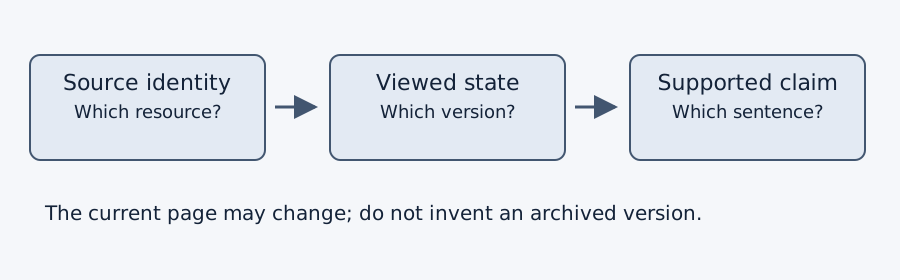
Decide what you are citing
A page may describe a dataset, display a filtered result, or publish an interpretation. Identify which of those supports the sentence in your article. Linking to a project homepage is rarely enough to show which record or version you read.
DataCite’s version 4.6 guidance on dynamic datasets describes several citation options: a defined subset, a snapshot, the changing dataset with access date and time, or a time-stamped query against versioned data. It warns that citing a changing dataset does not ensure later access to the state originally used. A query-based approach also depends on repository support.
Those are documented options, not features you can assume exist on an evidence website. Use the most specific source identity that the publisher actually provides. If there is no accessible version identifier, say so in your research record.
Fill in a citation record
The worksheet below is an original editorial adaptation for evidence pages. It is not a required metadata schema, and its fields do not describe a LaunchDetect API contract.
| Field | What to record | What it prevents |
|---|---|---|
| Creator and title | Credited organization or author and the source title | An unexplained bare link |
| Stable identifier or exact URL | Publisher-supplied identifier, record URL, or specific dataset citation | Substituting a broad homepage for the evidence |
| Viewed version | The displayed version or revision, otherwise “not supplied” | Inventing an immutable source state |
| Supporting location | Paragraph, section, figure, record ID, or query scope | Making readers search the whole resource |
| Observation time | The source’s stated acquisition time or interval, with its meaning and zone | Treating access time as observation time |
| Retrieval time | When you obtained the page, with a time zone | Leaving the viewed state undated |
| Relevant claim | The precise sentence the source supported at retrieval | Assuming the source supports the whole article |
| Change route | Version history, correction notice, or updated-source link, if available | Losing the path to a later revision |
Keep fields that matter to the cited object. An editorial standards page, for example, may have no observation time. “Not applicable” is more informative than inserting the article’s publication date into that field.
A synthetic citation you can inspect
The following example is fictional. “Example Observation Office,” the record name, version, and times are invented. No live URL or DOI is assigned to them.
- Creator and title: Example Observation Office, “Example scene note R-17”
- Source identity: R-17 in the fictional publisher’s record collection
- Viewed version: revision 2, as shown in the example
- Supporting location: figure 1 caption and timing note
- Observation interval: 2026-09-20, 12:00–12:02 UTC, as stated by the fictional source
- Retrieved: 2026-09-21, 09:15 UTC
- Supported claim: the source associates figure 1 with that acquisition interval
- Limitation: the citation does not independently validate the feature interpretation
- Change route: the fictional record’s revision notice
A compact citation in the article could identify the creator, title, R-17, revision 2, and retrieval time beside the link to the actual source when one exists. The acquisition interval belongs in the sentence or caption it describes. The longer research record preserves how that citation relates to the claim.
This structure prevents an easy mistake: replacing an observation interval with the exact time the writer opened the page. More digits in a retrieval timestamp do not make the observation more precise.
An identifier and a version answer different questions
A persistent identifier helps identify a resource, but check which version it represents. DataCite’s versioning guidance allows the same DOI with updated metadata for minor content changes and recommends a new DOI linked to the previous one for major changes. Resource stewards determine that distinction.
For a writer, the practical lesson is to read the landing page and version information rather than treating the identifier alone as a frozen copy. Preserve the supplied citation where appropriate, then add the particular version or access information needed for your use. Never manufacture a DOI, revision label, or publisher timestamp to make a citation look complete.
Preserve evidence only within its permissions
A publisher-provided version or snapshot can be useful when available. If you consider keeping or sharing your own copy, check the content’s reuse terms, privacy, and any third-party material first. Access to a page is not a blanket instruction to redistribute its contents.
A screenshot also has a limited role. It can document a visible display, but it may omit data, tooltips, processing details, and material outside the captured area. Record what was captured and what was not. A file hash can help identify a particular saved file; it does not establish that the file’s claims are correct or that redistribution is permitted.
This worksheet authorizes no upload or archiving action. When a permissible preserved copy is unavailable, retain the citation details and state the reproducibility limit honestly.
Respond when the source changes
Reopen the exact source and compare the part that supports your claim. Determine whether the change affects only presentation, the evidence itself, or your interpretation. Update the article if needed and link the relevant correction or version notice where one exists. Do not silently rewrite your earlier retrieval time as though the new source state had always been the one you used.
Use the evidence-lifecycle guide when the timestamp meanings need closer attention, and the source-linked brief to connect citations with a larger argument. A durable citation should make the original evidence choice inspectable, including the parts that cannot be reconstructed later.