What an editor should request with a cropped satellite image
Ask for the wider view, the original source record and the information needed to interpret the display. A crop can be an effective way to focus attention. The editorial problem arises when the handoff contains only the crop, leaving the editor unable to check what was removed or what the remaining colors and labels mean.
The most useful request is specific: send the crop together with its uncropped context, observation details, processing history, credit and proposed claim. That gives the next person a reviewable package without requiring them to reconstruct the entire investigation.
This guide supplies a copyable handoff checklist and a fictional example. It does not offer a forensic authenticity test or a finding about any real image.
Ask what the crop was meant to show
Begin with one sentence: “What should the reader learn from this crop?” The answer determines which missing context matters most.
A crop illustrating the appearance of a display needs a legible key. A crop used to discuss a particular event also needs the observation date and a separately supported event connection. A crop used for a geographic comparison needs enough orientation and surrounding context to understand the comparison. These are different editorial uses, even if the pixels are identical.
NASA's satellite-image interpretation guide emphasizes scale, orientation, color definitions and context. Those are useful prompts for a handoff. They do not imply that every crop needs an entire hemisphere printed beside it. Ask for enough surrounding material to evaluate the actual sentence the image accompanies.
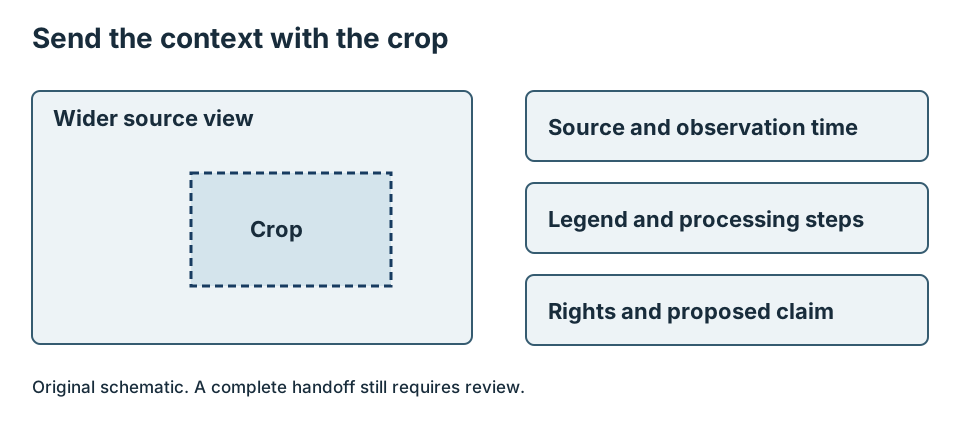
Original schematic. The small rectangle is an editorial selection, not a measured launch location.
A copyable crop handoff
Complete the following fields for one image. “Unknown” is a useful answer when it identifies a genuine unresolved question; an empty field can conceal one. This is a proposed editorial worksheet, not a required provider format.
| Request | What to supply | What it allows the editor to check |
|---|---|---|
| Uncropped context | The original frame or a wider view with the crop boundary marked | Whether surrounding features or labels change the reading |
| Original source | The source page and the scene, file or image identifier, when available | Whether the crop can be traced to a particular asset |
| Instrument and band | Platform, instrument, product and band or composite recipe | What the image is a view of, rather than what it resembles |
| Observation interval | Date, time zone and start/end times, or the exact documented time label | Whether the observation matches the event under discussion |
| Scale and legend | Geographic scale/orientation as applicable; full color key with quantity and units | Whether distance and color claims have a defined basis |
| Processing steps | Crop bounds, resizing/resampling, contrast or palette changes, and added overlays | Which elements came from the source and which were prepared later |
| Credit and rights | Original credit, asset-specific terms and any required permission record | Whether the intended reproduction and attribution have been addressed |
| Proposed claim | The exact caption or sentence the image will support | Whether the source can answer that specific question |
| Unresolved limits | Missing fields, uncertain interpretations and the next check needed | What must remain qualified or wait for more evidence |
The full frame is part of the review record even if the final article uses only the crop. Keep the relationship clear: label which file is the original source and which is the edited output. If the supplied “original” has already been colorized or annotated by a provider, say so. Do not describe it as raw sensor data unless that is what it actually is.
A fictional handoff with an honest outcome
Imagine receiving a small image named “launch-detail.png.” It contains a colored patch, a dot labeled “pad,” and a clock label. No other information accompanies it. The filename is a convenience chosen for this exercise; it is not evidence that a launch occurred.
An editor could send this request:
“Please send the wider frame with this crop marked, the original image link or identifier, and the platform, instrument and band. I also need the observation date and time-label meaning, the complete legend, any changes or overlays you added, and the image credit and reuse terms. What exact claim should this crop support, and what is still unresolved?”
Suppose the reply supplies the source and band, but reveals that the pad dot was added for orientation and the date is still unknown. Record the result plainly:
- Known: The crop can be linked to a source image, and the band is documented.
- Added by the preparer: The pad marker is an annotation.
- Unresolved: The observation date and the connection to the named event.
- Editorial consequence: Do not use this asset as evidence of that dated event until the missing match is established.
This outcome does not accuse the preparer of deception. It separates a recoverable handoff gap from the much stronger claim that an image is fabricated. It also gives the editor a next step: recover the observation date from the original record, then reassess the proposed caption.
Keep annotations and measurements distinguishable
Request an explanation of every arrow, outline, label and map pin that matters to the article. Ask what supplied its position. A label might identify a known site for context, while a colored feature comes from the imagery. Those roles should remain visible in the caption and in the preparation record.
For elevated features, a map position may require additional interpretation. The separate guide to plume parallax and map location explains that issue. Do not ask a crop checklist to resolve it by itself. Escalate a positional claim when its geometry matters to the story.
Similarly, an editor can identify that a legend is absent without deciding what the missing color scale must have been. Request the actual legend. A plausible replacement is still a replacement.
Treat rights as a separate part of the handoff
A source link helps establish origin. It does not automatically establish permission to reproduce the asset. NASA's LAADS image-credit guidance specifically asks users to consult each image's associated copyright and credit information. Check the actual image, including any third-party overlays, rather than relying on the reputation of its host website.
Reuters' standards emphasize proper attribution and visual accuracy. For this worksheet, the practical editorial recommendation is to preserve the creator's credit and explain relevant changes. This proposed checklist is not a statement that Reuters reviewed or endorsed the image.
No satellite frame is reproduced here. The diagram and fictional handoff are original teaching material.
Decide what can move forward
A complete handoff makes an image easier to review; it does not prove authenticity, establish a scientific interpretation or grant rights by itself. Check the supplied answers against the source and the intended use.
If the gap affects the article's main claim, hold that claim or choose a better-supported asset. If the image is useful only as background, label its purpose and date so readers do not mistake it for event evidence. If the gap is a missing credit instruction, resolve that before reproduction.
For a full claim-by-claim record, use the source-linked launch evidence brief. The crop handoff has a narrower job: make sure the editor can see what was selected, where it came from and what the selection can responsibly show.