How to report a launch scrub without recycling the wrong thermal image
Match a launch image to the particular attempt being reported, not just to the mission name. A mission can have several attempted launch dates. An image from a later liftoff cannot serve as evidence that liftoff occurred during an earlier scrubbed attempt.
Before choosing the illustration, write down four fields: mission identity, attempt date and state, image observation time, and image purpose. Keep the event record separate from the image record until the relationship is verified. This small check is particularly useful when a dramatic thermal animation already exists in an archive.
The example here is historical Artemis I. It makes no statement about any current launch schedule and presents no new thermal-image analysis.
The same mission had different event states
NASA's August 29, 2022 scrub notice states that the launch director halted that day's Artemis I attempt at approximately 8:34 a.m. EDT. The notice describes continuing checks rather than a liftoff. Preserve that event state when describing the day.
NASA separately reported Artemis I's liftoff on November 16, 2022, at 1:47 a.m. EST from Kennedy Space Center's Launch Pad 39B. These records concern the same mission but different dates and outcomes.
That is enough to expose the editorial trap. A search for “Artemis I launch image” can answer the mission question while leaving the attempt question unanswered. A familiar rocket or spaceport does not repair the date mismatch. Even an authentic, correctly credited image may be unsuitable evidence for the particular event being reported.
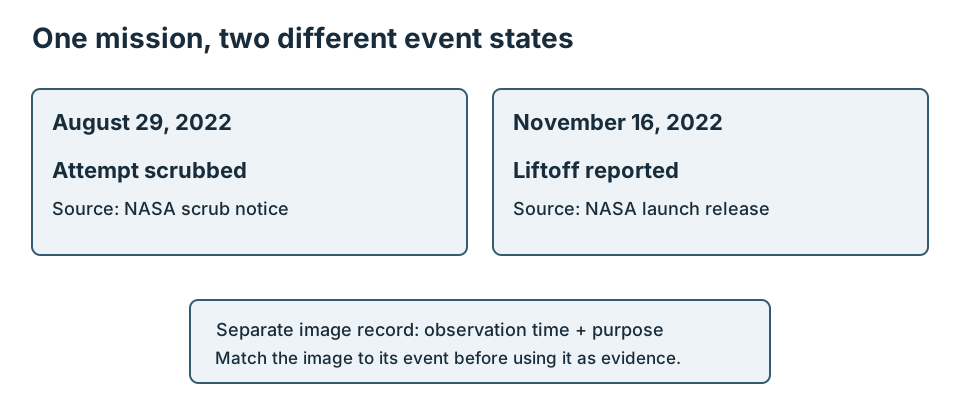
Original historical event-state schematic, based on the two linked NASA reports. It contains no satellite imagery and supplies no observation time for an image.
Use a four-field match before writing the caption
This original worksheet keeps the story's event and the proposed asset separate. Apply it to each image, including thumbnails and animated previews.
| Field | Question | Artemis I scrub-story example |
|---|---|---|
| Mission identity | Which mission, vehicle and source record does the story concern? | Artemis I; identify the NASA scrub report as the event source. |
| Attempt date and state | Which dated attempt is being reported, and what happened? | August 29, 2022; the attempt was halted, according to NASA. |
| Image observation time | When was this image acquired, and where is that time documented? | Not supplied by the event report for a proposed thermal frame; obtain its own source record. |
| Image purpose | Is the asset evidence of this attempt, dated historical context, or an illustration? | Decide only after checking the image record; do not default to event evidence. |
The third row is intentionally incomplete. An event report can establish a scrub without supplying the acquisition time of a satellite image. Filling that gap with the report's publication date would create information the image record has not provided.
If a source describes an observation interval, keep the interval. If a page supplies only a publication time, label it as publication time. If the image date cannot be established, do not use the image as evidence of the dated attempt.
The satellite-image evidence lifecycle explains the broader timestamp distinctions. Here the operational editorial question is simpler: does the image actually belong to the attempt named in the story?
Rewrite a misleading caption
Consider this hypothetical situation. An editor has verified that a proposed thermal animation depicts a later, successful liftoff on November 16. They are writing a retrospective about the August 29 scrub. No such animation is reproduced or independently analyzed in this article.
Hypothetical before: “Artemis I's August 29 launch lights up the satellite view.”
The sentence attributes liftoff imagery to an attempt NASA reported as halted. Changing “launch” to “launch attempt” while leaving the rest of the caption alone would still encourage the wrong event association.
Safer choice: Replace the asset with an appropriately sourced view of the August 29 attempt, if one can be verified and used with the required rights. Its caption should say what it actually shows, such as the vehicle on the pad, rather than suggesting a flight occurred.
If the later image is genuinely needed for a historical comparison: “Historical comparison: this separately sourced image depicts the later November 16, 2022 liftoff. It does not show the August 29 attempt, which NASA reported was halted.”
That rewritten caption is conditional on the hypothetical image's provenance and rights having been checked. It does not grant permission to reuse an asset. The date and purpose must be visible next to the image, not buried far below it in an article where they may be missed when the image is shared.
A scrub report does not need a dramatic launch picture
The simplest reliable presentation may be a text-led story with a source link. If an image does not help readers understand the actual event, leave it out. A compelling launch signature can introduce more confusion than information when the story concerns an attempt that did not lift off.
A dated pad photograph, a clearly labeled diagram or a verified view from the attempt may be suitable, depending on the story and the asset's rights. These alternatives still need accurate captions. “File image” alone may be too vague when the specific date is what prevents a misunderstanding.
Likewise, the absence of an obvious thermal feature in a chosen frame is not the basis for reporting a scrub. In this historical example, the scrub state comes from NASA's notice. The image question is whether the chosen visual is consistent with that report and accurately described.
For the meaning of countdown language, consult the separate countdown terms guide. Do not turn a temporary hold, a scrubbed attempt and a completed liftoff into interchangeable caption labels.
Check the whole published presentation
Before release, an editor should inspect the headline, caption, thumbnail, image alternative text and any preview description together. A careful caption cannot fix a thumbnail that still labels a scrub as liftoff. Carry the date and the image's purpose into the parts of the presentation that people may encounter independently.
Apply this review to every place the asset is used. If the wrong image has already been used, correct the affected presentation and explain a substantive change clearly. Reuters' standards support transparent corrections, including captions and graphics.
Finally, keep a record of the pairing decision: which event source established the attempt state, which source established the image time, and why the image was included. The source-linked evidence brief can hold that longer record.
The best safeguard is a specific match. “Artemis I” identifies a mission. “The August 29, 2022 attempt was scrubbed” identifies the event being reported. The image has to earn its place beside that second sentence.