Writing a thermal-image caption that does not overclaim
A thermal-image caption should let a reader trace the picture back to its source and understand the narrow observation being described. Start with the instrument and observation time, explain what the display represents, then separate the visible feature from any proposed explanation. If the evidence stops at a colored patch, the caption must stop there too.
The practical challenge is compression. A caption has much less room than an evidence brief, yet it often travels farther: someone saves the picture, crops the article, or shares the image without its surrounding paragraphs. The few words beneath it may become the only surviving account of what was measured.
This guide offers three fictional rewrites and a six-part caption worksheet. None describes a newly analyzed launch or an actual satellite frame.
Begin with the quantity behind the picture
The word “thermal” does not identify a complete product. NOAA's GOES-R product guide distinguishes radiance data from derived Cloud and Moisture Imagery. Its infrared imagery products include brightness temperatures. A caption should preserve the actual product's quantity and units rather than quietly replacing them with the temperature of an object.
That distinction changes the wording. “A region appears yellow in this display” describes appearance. “The labeled brightness-temperature value is higher than in the comparison frame” describes a comparison that requires data and matching scales. “The rocket exhaust reached this temperature” is a different scientific claim and cannot be obtained by renaming the legend.
NASA's satellite-image interpretation guide emphasizes scale, color meaning and context. Use those as questions for a caption, not as details to remove when space is tight. A precise sentence can still be short if it avoids unsupported conclusions.
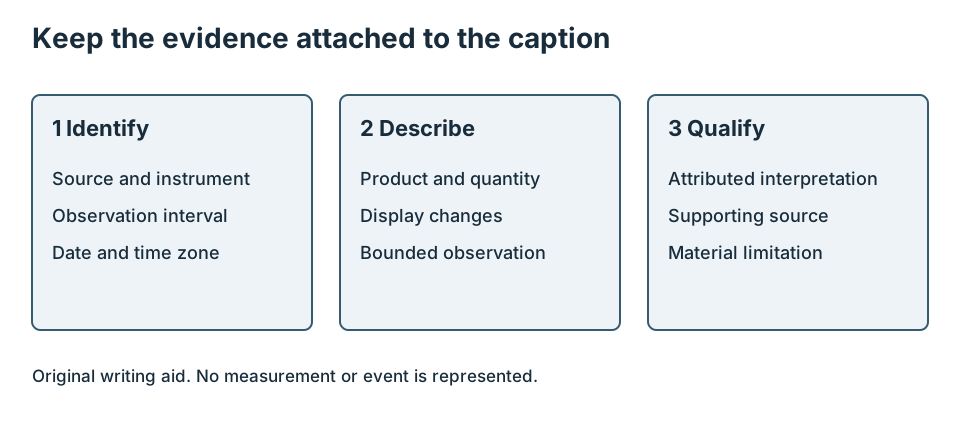
Original editorial diagram. The sequence describes writing choices, not a sensor-processing pipeline.
Rewrite one claim at a time
The examples below are deliberately synthetic. Bracketed fields are items to obtain from the real source, not values to guess. They are training examples, not ready-to-use captions for an unidentified image.
Example 1: A color becomes a temperature claim
Hypothetical before: “The red spot shows the rocket's scorching exhaust temperature.”
Better, once the stated metadata is verified: “A red patch appears in this false-color infrared crop from [platform and instrument], observed during [interval and time zone]. The display maps [documented quantity and units] to color; it does not establish the physical temperature of a rocket's exhaust.”
The repair removes an unmeasured number even though the original never printed a numeral. “Exhaust temperature” is already a measurement claim. If the product quantity and legend cannot be recovered, write that they are unavailable and do not offer a temperature interpretation. A phrase such as “extreme heat” would merely hide the same unsupported conclusion behind an adjective.
Example 2: An annotation becomes an identification
Hypothetical before: “The satellite confirms the launch at the marked pad.”
Better, for a schematic teaching example: “In this fictional scene, an added marker identifies the launch site used for context. The colored feature is part of the illustrative image; its identity and its relationship to the marker have not been established.”
For a real image, replace “fictional scene” only after verifying the scene's provenance. Then describe the feature in words the source supports. If an identified analyst attributes it to a launch, name and link that analyst. An arrow or map label tells readers where to look; placing it there does not supply the evidence for the interpretation.
Example 3: A frame label becomes an exact event time
Hypothetical before: “Liftoff occurred at exactly 12:00:00 UTC, as this frame proves.”
Better, if the source supplies only the displayed label: “This example frame carries a 12:00 UTC label. The underlying observation interval has not been supplied, and the label alone does not establish the instant of liftoff.”
The 12:00 label is invented for this exercise. Notice that the revised caption does not pad it with seconds. Before describing a real timestamp as an acquisition time, find out what it labels. Before calling it a liftoff time, obtain evidence of that event. These are separate checks even when the printed clock values happen to match.
Fill in six caption fields
Use this worksheet before shortening the prose. It is an editorial aid, not an instrument specification or a LaunchDetect API schema.
| Field | Fill in | If it is missing |
|---|---|---|
| Source and instrument | Original scene or image link; platform; instrument; responsible provider | Identify the gap. Do not name a platform from visual resemblance. |
| Time | Observation start/end or the source's exact time label, with date and time zone | Describe it as an unverified label; omit an event-time claim. |
| Band or quantity | Band/composite, product, displayed quantity and units | Do not translate color into a physical measurement. |
| Transformation | Crop, palette, contrast adjustment, resampling and added annotations that matter | Request the preparation record before comparing appearances. |
| Observation | A limited description of what can actually be seen or read | Avoid identifying a cause just to make the caption more interesting. |
| Interpretation and limit | Whose interpretation this is; supporting link; unresolved question | Keep the feature unattributed if the evidence cannot establish its cause. |
A fill-in sequence is: “From [provider/source], [platform/instrument] observed [scene] during [date, interval and zone]. This [band/product] view displays [quantity/units] using [transformation]. [Bounded observation]. [Attributed interpretation, if supported], with [material limitation].”
Not every finished caption needs all six sentences. The worksheet exists to expose missing evidence before editing. Move supporting details to a clearly linked record if space is limited; retain the limitation that would most change a reader's understanding of the image.
Make the uncertainty specific
“Possibly a launch” can sound cautious while leaving readers with no way to judge the possibility. A more useful limit names the missing step: “The source scene is identified, but the feature has not been matched to an independently reported event.” Another might be: “The observation interval is known; the physical temperature of the source has not been retrieved.” Choose the limit that applies rather than attaching a standard disclaimer to every caption.
Reuters' sourcing guidance calls for clear attribution and explicit acknowledgment of unknowns. Applied here, that means keeping the person making an interpretation visible. “The source analysis identifies…” is appropriate when summarizing that analysis. It does not imply that this desk repeated the analysis.
Read the caption once with the image hidden, then once with the article hidden. Can a reader still distinguish the source, the observation and the inference? If not, revise the sentence that merges them.
For the physical limits behind these wording choices, read what a satellite thermal signal says about a launch. When a caption needs a larger supporting record, use the separate source-linked evidence brief. A caption should provide the way into that record without pretending to contain the whole investigation.