Launch Watch · Spaceflight
Published
Apollo 11’s fuel margin: what the 45 seconds and 770 pounds actually counted
Reconcile Apollo 11’s 30-second call, 45-second depletion estimate and 770-pound propellant remainder with the mission report’s clocks and mass ledger.
The familiar “30 seconds” call near Apollo 11’s landing and the mission report’s 45 seconds of remaining firing time answer different questions. The call referred to a landing decision limit. The report diagram counted toward calculated propellant depletion. A later calculation put oxidizer tank 2 depletion at 50 seconds after engine cutoff.
There is a second distinction hidden in the story: the reported 770 pounds left at cutoff included both fuel and oxidizer, including material in the manifold. Fuel alone accounted for 251 pounds. Read together, the clocks and the mass ledger explain why choosing one dramatic number can make the landing sound more precisely measured than the record supports.
First, account for all 770 pounds
The Apollo 11 Mission Report, printed page 9-32, separates the descent propulsion system into fuel and oxidizer columns. Its cutoff entries give four components. Adding them independently reproduces the report’s total.
| Location | Fuel (lb) | Oxidizer (lb) | Combined (lb) |
|---|---|---|---|
| Tanks | 216 | 458 | 674 |
| Manifold | 35 | 61 | 96 |
| Total | 251 | 519 | 770 |
The fuel column is 216 + 35 = 251 pounds. The oxidizer column is 458 + 61 = 519 pounds. Together they make 770 pounds. Calling that whole remainder “fuel” is understandable conversational shorthand, but it loses a distinction that matters when interpreting an engine’s remaining operating capability.
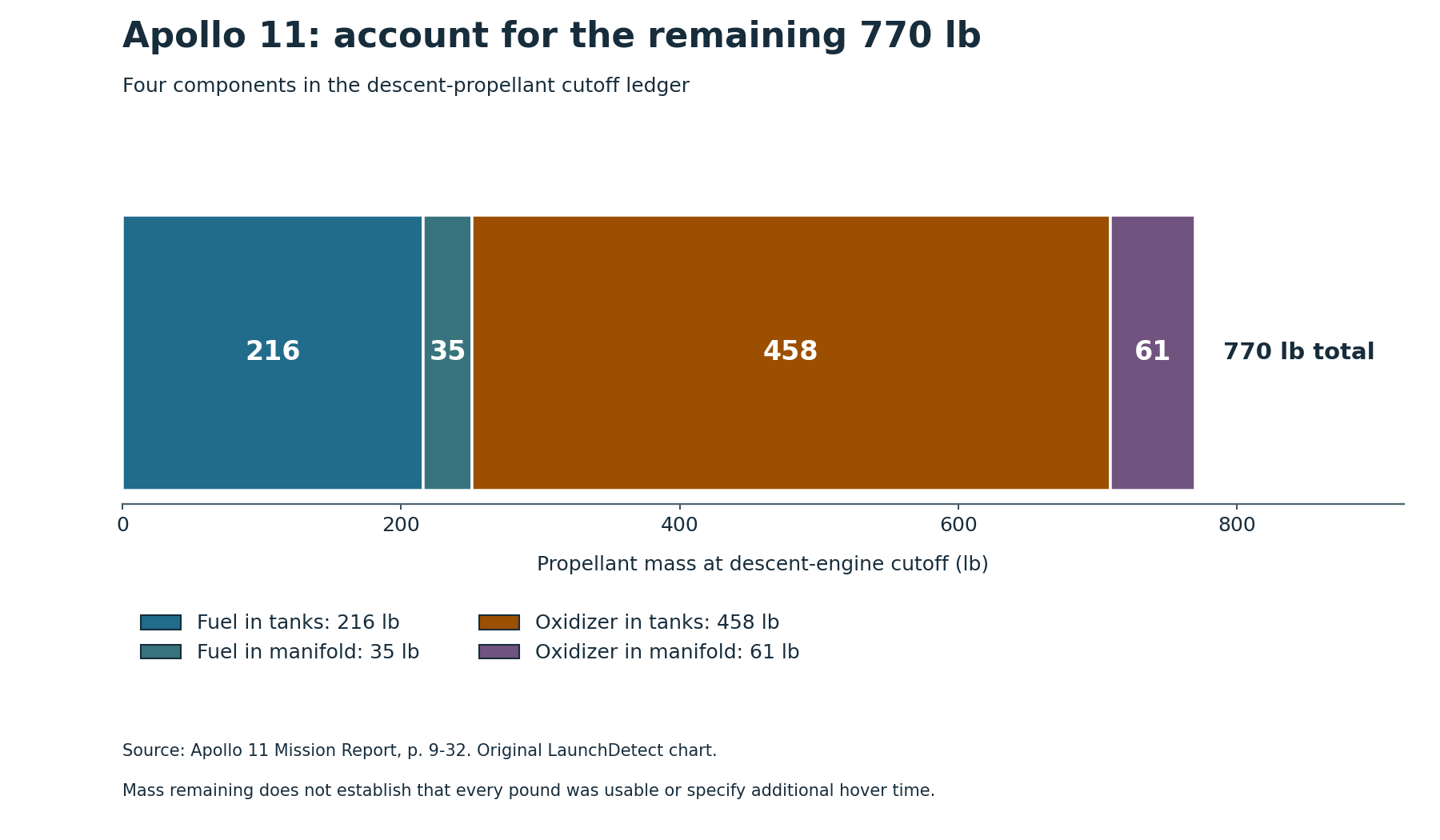
The manifold entries total 96 pounds, or about 12.5% of the recorded remainder. Counting only the tanks would give 674 pounds and omit part of the report’s accounting. Counting all 770 pounds, however, does not establish that every pound was usable before the first limiting tank or feed condition stopped the engine.
The 45-second figure ends at depletion
On printed page 9-24, the report places engine cutoff at an indicated 45 seconds of firing time remaining. The same diagram places the landing go/no-go point 20 seconds before calculated depletion. Subtraction leaves 25 seconds between those two indicated points: 45 − 20 = 25.
| Quantity | Seconds | What the number describes |
|---|---|---|
| Indicated remaining firing time at cutoff | 45 | Time to calculated propellant depletion |
| Landing go/no-go decision point | 20 | Reserve before calculated depletion |
| Postflight calculation at cutoff | 50 | Time to oxidizer tank 2 depletion |
That 25-second result is an audit of the report diagram. It is not a newly timed reconstruction of the descent audio. It also preserves the decision reserve: reaching the go/no-go point and exhausting propellant were different events in the landing logic.
The report compares the indicated 45 seconds with a postflight calculation of 50 seconds to oxidizer tank 2 depletion. It explicitly says the five-second difference was within the measurement accuracy of the system. The later number is therefore not evidence that someone observed the engine running for an extra five seconds; the engine had already been shut down.
Where the “30 seconds” call fits
The Apollo Lunar Surface Journal landing transcript records Charlie Duke’s call at mission elapsed time 102:45:31, with an editorial clarification that it counted toward the “Bingo” call. This mission clock is elapsed mission time, not a UTC time of day.
The transcript’s call and the report’s cutoff estimate need not have identical values: they refer to different moments and different endpoints. The useful reading question is “seconds until what?” before it is “how many seconds?” A decision call made before touchdown should not be relabeled as a direct measurement of empty tanks at cutoff.
A precise audio-based reconstruction would need to reconcile event definitions and the source timestamps. This article does not attempt that reconstruction. The report’s prose and event material are not a warrant to combine every quoted timestamp into a single exact countdown.
How far below the planned remainder was the landing?
The same table lists 18,184 pounds loaded and a planned remainder of 957 pounds. The recorded 770-pound remainder was 187 pounds lower: 957 − 770 = 187. Expressed against the planned remainder, that shortfall is about 19.5%.
A different denominator answers a different question. The cutoff remainder was about 4.23% of the loaded descent propellant: 770 ÷ 18,184 × 100. That is a mass-accounting fraction. It cannot establish that 4.23% of the available landing time remained, because engine thrust, propellant consumption and the limiting tank condition are not encoded in that percentage.
The report attributes the higher-than-predicted descent-system usage to maneuvering to avoid a large crater late in the descent. Its preflight budget already included allowances for landing-point redesignation and manual hover. The comparison here uses the table’s complete planned remainder rather than treating every departure from nominal usage as unbudgeted.
Method and limits
We transcribed the four cutoff mass entries and the three time definitions from printed pages 9-24 and 9-32, checked them against the report pages, and independently added and subtracted the values. The four-component mass CSV and time-definition CSV preserve the inputs used here.
No fuel-flow curve, throttle history or usable-propellant model is fitted. The report’s ascent propulsion quantities belong to a separate system and are excluded. Neither 770 pounds nor the loaded-mass percentage has been converted into additional hover time.
For a source-linked account of the landing, keep the result in two sentences: the report indicated 45 seconds to calculated depletion at cutoff, with a 20-second decision reserve; its cutoff mass ledger totaled 770 pounds of descent propellant, of which 251 pounds was fuel. Those sentences retain what each quantity measures without making the records compete for one supposed “fuel left” number.
Sources
- Apollo 11 Mission Report (1969). Printed pp. 9-23 to 9-24 and 9-31 to 9-32; PDF pp. 180-181 and 188-189. Key pp.181/189 visually inspected.
- Apollo Lunar Surface Journal: The First Lunar Landing. 102:45:31 callout and postflight propellant commentary. Prefer the report for exact component terminology.
Charts and calculations: LaunchDetect, using the linked factual records. No NASA or JPL endorsement is implied.