Launch Watch · Evidence study
Published
Chelyabinsk: comparing radiated light with estimated impact energy
Convert Chelyabinsk’s reported radiated energy to 89.6 kt, compare it with the 441-kt impact estimate, and keep source revisions visible.
The Chelyabinsk fireball appears in a retrieved NASA/JPL catalog row with two energy numbers: 37,500 and 441. Comparing those bare numbers would be a mistake. The first is reported optical radiated energy in units of 1010 joules; the second is estimated total impact energy in kilotons of TNT.
Putting them into the same unit yields about 89.6 kilotons for radiated energy and 441 kilotons for the impact estimate. Our calculation makes the scale difference visible while preserving the distinction between a reported sensor-derived quantity and a model-derived estimate.
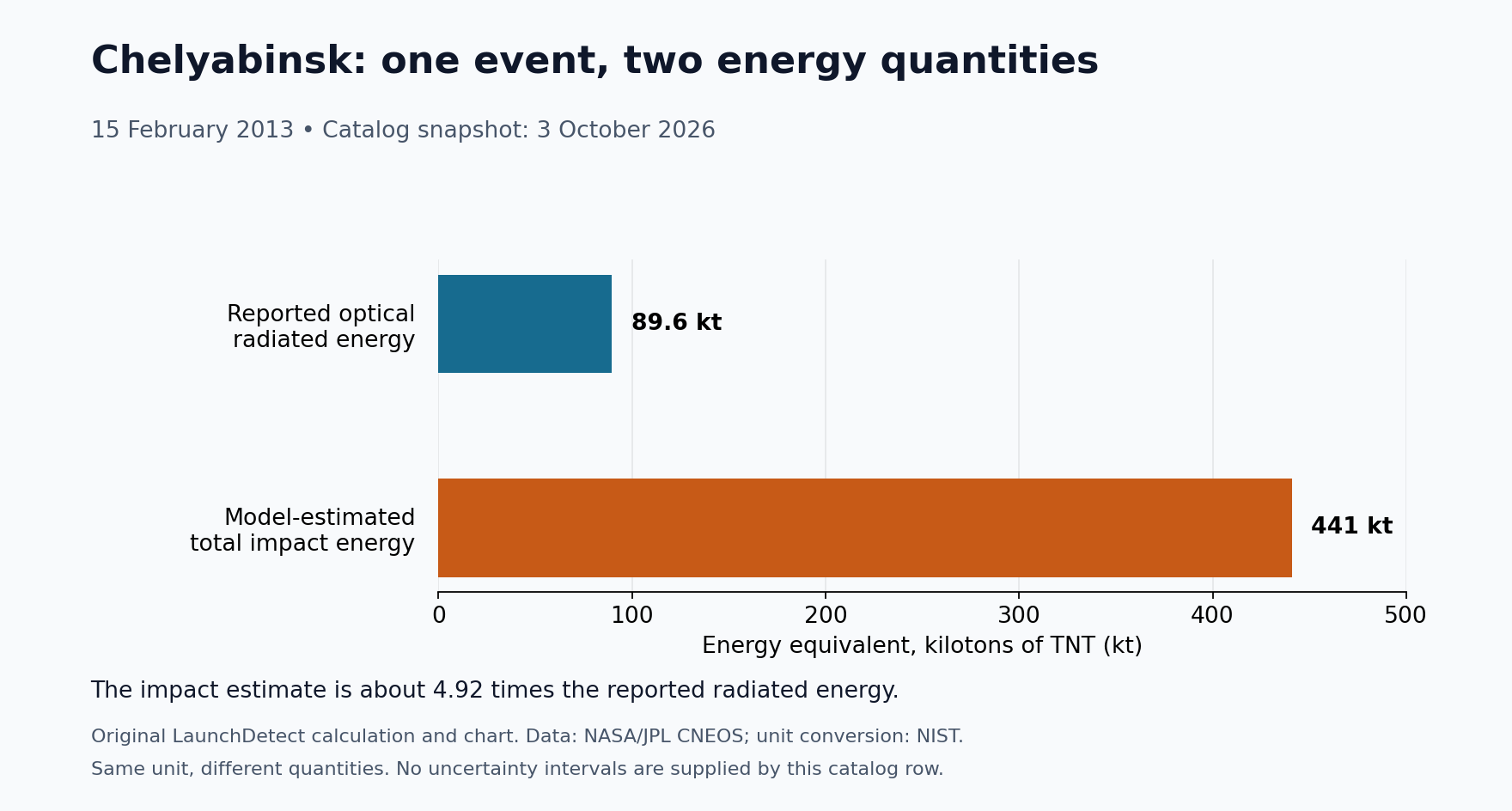
Decode the row before interpreting it
The response identifies API version 1.2 and contains one record. We associated each value with its name in the returned fields array, rather than assuming a fixed column position. The API documentation defines the date as the time of peak brightness and identifies the energy units.
| Quantity | Catalog entry | Converted value used here |
|---|---|---|
| Peak-brightness time | 2013-02-15 03:20:26 | GMT, as defined by the API |
| Approximate optical radiated energy | 37500 × 10¹⁰ J | 3.75 × 10¹⁴ J ≈ 89.6 kt TNT |
| Approximate total impact energy | 441 kt TNT | 1.845144 × 10¹⁵ J (arithmetic conversion) |
The table deliberately uses “reported” and “estimated.” CNEOS explains that these records derive from U.S. Government sensor detections supplied for public release, and that CNEOS does not independently reanalyze them. Our work is a reproducible reading of that record, not a new reduction of sensor observations.
Convert the units without changing the quantity
The radiated-energy entry gives 37,500 × 1010 = 375,000,000,000,000 joules. NIST’s conversion table gives 4.184 × 10⁹ joules per ton of TNT equivalent, or 4.184 × 10¹² joules per kiloton. Dividing yields 89.627… kilotons, displayed here as about 89.6.
The catalog’s 441-kiloton impact estimate divided by that converted radiated energy gives approximately 4.92. This ratio is specific to these two entries. It is not a universal multiplier for meteors, a detection-efficiency measurement or a comparison of explosion damage.
Show the arithmetic and the empirical-model cross-check
- Radiated joules: 37,500 × 1010 = 3.75 × 10¹⁴ J.
- Radiated TNT equivalent: 3.75 × 10¹⁴ ÷ 4.184 × 10¹² ≈ 89.627151 kt.
- Impact-to-radiated ratio: 441 ÷ 89.627151… = 4.920384.
CNEOS’s introduction gives the empirical relationship E = 8.2508 × Eo0.885, where both the optical radiant energy Eo and estimated impact energy E are expressed in kilotons. Substituting our unrounded 89.627151…-kt conversion produces about 441.0 kt, consistent with a catalog entry rounded to 441 kt.
CNEOS’s introduction uses 4.185 × 10¹² J per kiloton in its explanatory conversion; this article consistently uses NIST’s 4.184 × 10¹². That small convention difference does not change the rounded 441-kt cross-check. This checks numerical consistency with the stated relationship. It does not independently validate that relationship for this event or quantify its uncertainty. Download the two-quantity calculation table.
The historical release differs slightly from the current row
The CNEOS explanation published on 1 March 2013 lists maximum brightness at 03:20:33 GMT and approximate impact energy of 440 kt. The API snapshot retrieved on 3 October 2026 lists 03:20:26 and 441 kt. The historical release’s radiated energy, 3.75 × 10¹⁴ J, agrees with the converted catalog value.
Those are seven seconds and one kiloton of difference in the displayed records. The sources inspected here do not document the reason. We therefore preserve both versions and their dates instead of combining the earlier timestamp with the later energy estimate or attributing the differences to an unverified correction.
What this comparison can support
The useful conclusion is modest and concrete: the two energy fields describe different quantities, their units must be aligned before comparison, and the impact estimate has a documented empirical basis. A bar chart can make the difference easier to read without pretending the bars are two independent direct measurements.
The retained row does not provide a raw light curve or uncertainty intervals, so we do not invent either. Its peak-brightness time should not be relabeled as ground-impact time. The historical catalog is also neither a real-time feed nor a complete record of all fireballs. When reusing an event, keep the field name, unit, source version and retrieval date beside the number. That small ledger prevents a large interpretive error.