Launch Watch · Evidence study
Published
Crew-13 launch status: what EventScheduled actually means
A worked Crew-13 record comparison separates NASA liftoff evidence, LaunchDetect status, Schema.org semantics and timestamp precision.
On October 3, 2026, a captured LaunchDetect Crew-13 page displayed LAUNCHED while its structured data contained EventScheduled. That looks inconsistent if both labels are read as answers to “has the rocket lifted off?” Their definitions make the comparison more interesting.
NASA’s mission blog reported actual liftoff on October 1 at 11:10 a.m. EDT. Schema.org allows EventScheduled to describe an event that has already happened as scheduled. The captured page also retained future-tense invitations and an extra six seconds in its timestamp. Each finding needs its own evidence and interpretation.
Three records answering different questions
The official NASA Crew-13 blog index includes the October 1 entry announcing liftoff and states that it occurred at 11:10 a.m. EDT. That is evidence of an actual event, rather than only a planned opportunity. We use the working index as the public citation for this bounded time claim.
The October 1 LaunchDetect page had an explicit LAUNCHED row in its visible table. Its JSON-LD, the machine-readable data embedded in the page, gave startDate as 2026-10-01T15:10:06Z and eventStatus as https://schema.org/EventScheduled. Both values are reported here as captured site fields, without assuming that their data lineage has been independently verified.
The third record is the Schema.org definition of EventScheduled. Its meaning includes an event taking place, or already having taken place, on its scheduled start date. It is also an optional/default value. That vocabulary is broader than a site-specific launch status called “scheduled.”
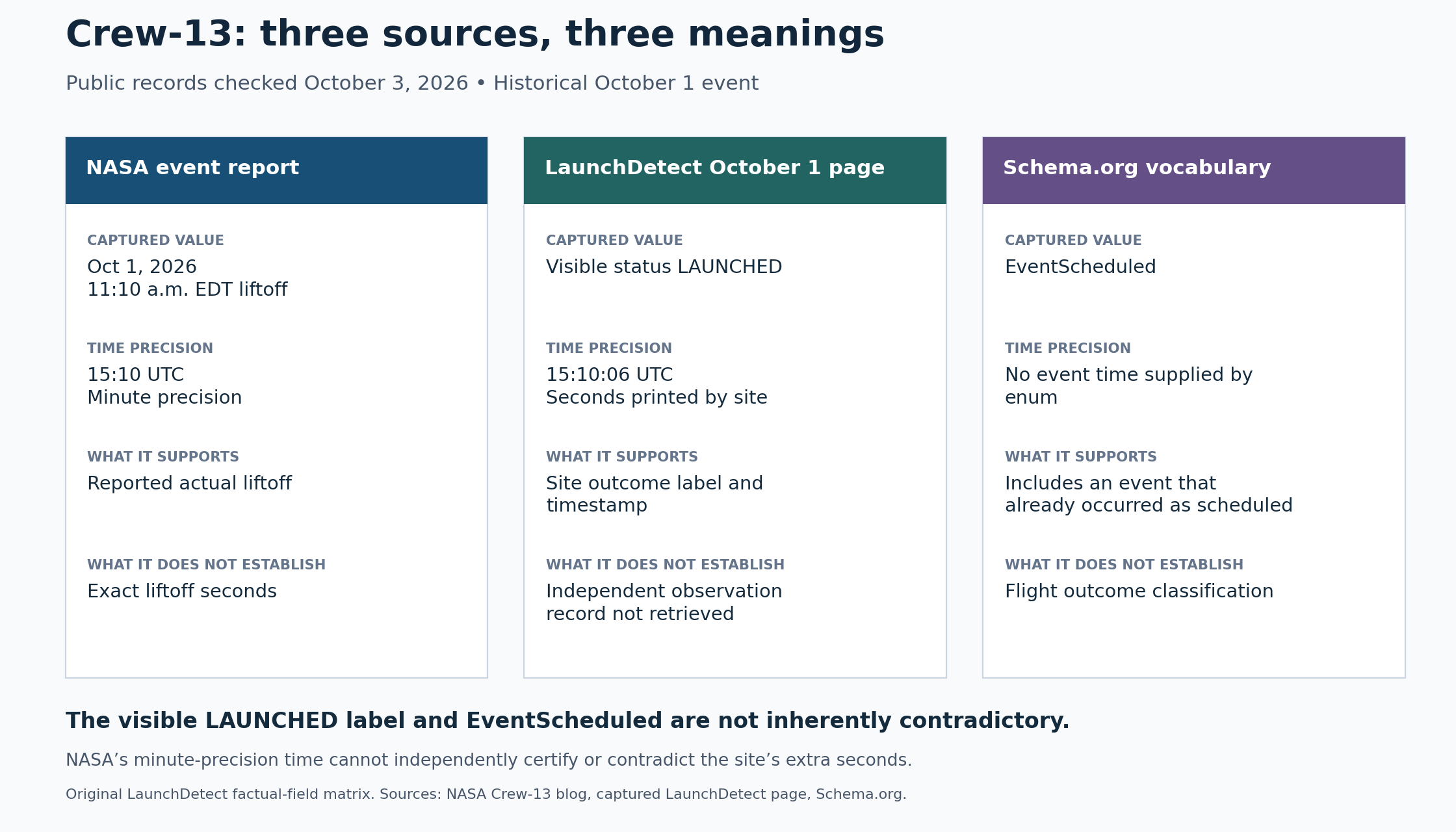
The result of this first comparison is narrow but useful: LAUNCHED and EventScheduled do not inherently contradict one another. The two strings belong to different status systems. That conclusion does not certify every other field or sentence on the page.
Do not manufacture a six-second disagreement
EDT is UTC−4. Add four hours to NASA’s reported 11:10 a.m. and the result is 15:10 UTC on October 1. Keep the output at minute precision, because that is the precision supplied by the report.
The site prints 15:10:06Z. Those extra seconds are neither independently established nor contradicted by a report that gives only 15:10. Treating the latter as an exact 15:10:00 measurement would add information the source never supplied.
Check the time comparison step by step
- Reported event: October 1, 2026, 11:10 a.m. EDT.
- Offset conversion: add four hours.
- Supported UTC rendering: October 1, 2026, 15:10 UTC, at minute precision.
- Captured site value: October 1, 2026, 15:10:06Z.
- Conclusion: the extra seconds require their own source. The two printed values alone do not establish a six-second discrepancy.
The report’s publication date, its event time and our October 3 capture date are separate fields in the retained factual field data.
The NASA entry is dated October 1, but a post’s publication clock is not automatically the launch clock. Here the event time comes from the wording of the report itself. That distinction prevents an ingestion pipeline from silently replacing an event timestamp with a publishing timestamp.
The older dated page needs a separate identity check
We also captured the September 12 Crew-13 route. Both dated URLs returned HTTP 200, and fresh reads during this review matched the retained snapshots byte for byte.
| Dated route | Structured startDate | Visible outcome row |
|---|---|---|
| September 12, 2026 | 2026-09-12T22:04:00+00:00 | No explicit outcome status in the captured table |
| October 1, 2026 | 2026-10-01T15:10:06Z | LAUNCHED |
Both snapshots use the same mission name and identify Space Launch Complex 40. Those shared fields make them candidates for duplicate-record investigation. They do not prove that both records carry the same stable upstream mission identifier: that identifier was not exposed in the captured fields. This review therefore does not claim a completed merge or establish which record should be redirected.
Both pages also retain “is scheduled to fly” wording and invitations to follow the launch when it occurs. On these dated snapshots, that future-facing copy is a distinct editorial issue to reconcile with the confirmed historical event. It should not be confused with the semantics of the Schema.org enum.
Launch confirmation and independent detection need different evidence
NASA’s report supports saying that the launch occurred. A page’s LAUNCHED label records what that site says about the outcome. Neither supplies a retrievable, mission-linked observation record demonstrating independent LaunchDetect detection.
No such observation record was retrieved in this review. That is a statement about the evidence inspected, not a claim that detection did or did not occur. A defensible independent-detection claim would need the actual observation record, its timestamp and provenance, and an established link to the mission. Generic product copy about publishing independent records cannot substitute for those case-specific fields.
Fix the interpretation before fixing the field
The EventStatusType enumeration lists EventCancelled, EventMovedOnline, EventPostponed, EventRescheduled and EventScheduled. It does not supply an EventCompleted member. Replacing a valid value with an invented completion enum would create a new problem.
For this Crew-13 case, keep three conclusions separate: actual liftoff is supported by NASA’s dated report; the visible site outcome and Schema.org scheduling value can coexist; and independent detection remains unestablished by the inspected evidence. Then address the future-facing copy and candidate duplicate records through their own checks. Reading each field in its own vocabulary avoids both false alarms and unsupported certainty.