Launch Watch · Current evidence
Published
Curiosity’s Basque Lakes images: two products, two kinds of clock
Two MAHLI records share Sol 5023 but record a focus merge and an exposure. An original metadata audit explains their times, focus counts and limits.
Two close-up records linked from Curiosity’s new Basque Lakes report both say Sol 5023, but their clocks describe different events. One time records an onboard focus merge; the other records an individual exposure. Our audit finds a gap of 9 hours, 32 minutes and 31 seconds between those reported timestamps. That arithmetic is straightforward. Calling it the time between two photographs would lose an important part of the evidence.
NASA’s Curiosity report was published October 4 and updated October 5. It carries a September 25 Earth planning date, while the two image records have September 22 and 23 timestamps. Keeping publication, planning and image-product dates separate is the first step toward reading what the rover actually did.
Start with the record, then read the clock
The record numbered 1642009 describes a color product generated on Mars by combining images taken at different focus positions. Its September 22 timestamp is when Curiosity performed that merge. The record numbered 1642018 describes a single MAHLI acquisition on September 23. NASA’s mission-report caption identifies that acquired frame as a view after a rock-stability pre-load test.
| Field | Focus-merge record 1642009 | Exposure record 1642018 |
|---|---|---|
| Reported sol | 5023 | 5023 |
| Reported UTC timestamp | September 22, 2026, 18:23:39 | September 23, 2026, 03:56:10 |
| What the timestamp describes | Onboard merge operation | Image acquisition |
| Focus motor count | 15,078 | 13,511 |
| What that count describes | Lens position of first input image | Lens position at exposure |
| Downloaded JPEG dimensions | 1,584 × 1,184 pixels | 1,632 × 1,200 pixels |
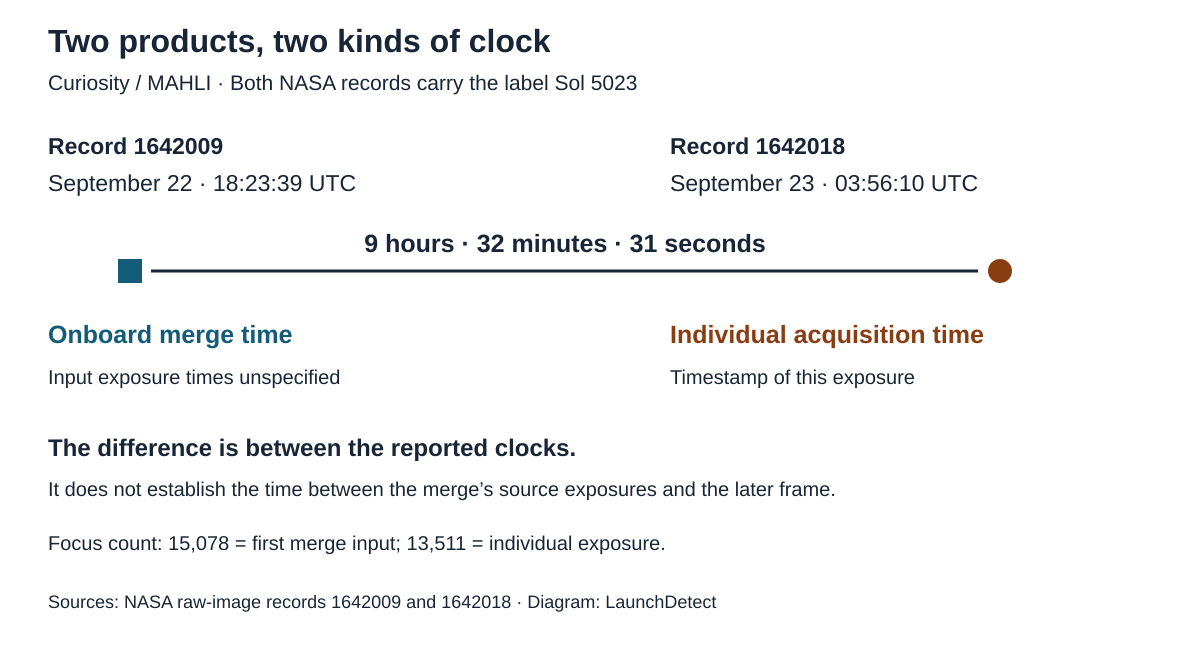
Subtracting the timestamps after parsing both as UTC gives 34,351 seconds. The dates straddle midnight on Earth, while both NASA records carry the same Martian-sol label. The table preserves those source labels rather than deriving a replacement sol number from an Earth date.
The unknown is the time of each image that went into the merge. NASA’s record says an onboard focus merge can use images from the same sol or an earlier sol. The merge timestamp therefore cannot be assigned to every constituent exposure, and the two records do not establish a 9-hour photographic before-and-after sequence.
What the rover combines, and what it sends back
NASA’s focus-merge description says MAHLI can combine between two and eight images of the same target taken with different focus positions. The goal is a product with more features in focus. Each merge generates a color best-focus image and a black-and-white product carrying information used to estimate the focus position associated with elements of the color image.
The record gives that generic two-to-eight range, rather than an exact input count for this particular merge. It would be unsupported to call record 1642009 an eight-image stack. Likewise, the existence of two output products does not establish how many bytes were saved in transmission. That would require the actual inputs, encoding and output file sizes.
This is useful context for a close-up image. A sharply focused view can contain contributions from several lens positions. It need not represent a single instantaneous exposure with one focus setting. The output remains a real camera-derived product, with processing that belongs in its description.
A focus motor count needs its field definition
For the merged product, 15,078 identifies the lens position of the first input image. For the individual exposure, 13,511 identifies the internal lens position when that frame was acquired. Subtracting these numbers would give a difference in motor counts, without establishing a camera-to-rock distance or the movement of a geological feature.
The individual-frame record includes approximate examples relating motor positions to close-up distances under stated conditions. We do not interpolate those examples into a precise distance for these two records. Nor do the JPEG dimensions supply the missing scale: 1,584 × 1,184 and 1,632 × 1,200 describe image arrays, not a calibrated ground resolution.
What the Basque Lakes report actually establishes
The mission team’s written account says it successfully drilled the Basque Lakes target. That operational statement is the source for the drilling history. The pair examined here is not a registered pre-drilling and post-drilling comparison, and we do not infer a new hole or a rock change by comparing differently framed products.
The report describes MAHLI’s role in examining texture alongside composition-related observations from APXS and ChemCam. It anticipates CheMin X-ray diffraction analysis in the September 25 planning account and later delivery to SAM. The NASA instrument overview explains these instruments’ different roles. Those planned analyses cannot be turned into a specific mineral result merely because a close-up photograph is available.
The strongest reading is therefore also the most useful one: the images document targets and imaging products, while the written operations account supplies the drilling context. Published analytical results would be needed to say what the drilled sample’s mineralogy revealed.
Reproduce the two-record audit
The downloadable CSV contains each raw-record ID, product description, reported sol, fully dated UTC timestamp, timestamp meaning, focus count, focus-count meaning and verified JPEG dimensions. To reproduce the clock calculation, convert the two timestamp strings to UTC instants and subtract the earlier reported time from the later one. Divide 34,351 seconds into hours, minutes and seconds to obtain 9:32:31.
Keep the meaning columns with the numerical ones when reusing the file. They are what prevent a valid time subtraction from becoming an invalid claim about acquisition history. The original images can be inspected through the NASA links below; this article’s visual is an original metadata diagram.