Launch Watch · Dashboard evidence
Correction prepared .
Published
Transporter 18 imagery before detection publication: a dated dashboard search audit
A retained 5 October, 02:29 UTC dashboard audit found 39 Transporter 18 thermal frames before its detection appeared in the public index. A dated update records the changed source classification.
Searching for “Transporter” in LaunchDetect’s Detections view returned no matching card. Switching the same search to All launches revealed Transporter 18 with 39 thermal frames and a permanent report.
That was the result in the public dashboard inspected on 5 October 2026 at about 02:29 UTC, or 4 October in Hawaii. The record’s detail panel explicitly said “No confirmed detection published.” Its imagery could be opened, but the presence of images did not change that confirmation state. This is a practical case for checking the selected view before drawing a conclusion from an empty search.
How we recovered the record in the original snapshot
We started at the LaunchDetect dashboard. The search box was labeled “Filter events by mission or site name.” These steps describe the retained 02:29 UTC Transporter 18 inspection:
- We entered Transporter. With Detections selected, this capture showed no matching launch card.
- We switched to All launches without changing the search. We left Past enabled. The main counter changed to 1 of 37 events, and the visible result was Falcon 9 Block 5 | Transporter 18 (Dedicated SSO Rideshare).
- We selected the card and checked the mission and site, Space Launch Complex 4E, rather than relying on a partial text match.
- We read the Detection field. For this record, it said no confirmed detection was published. Separately, the card listed 39 thermal frames and the replay was usable.
- We opened View launch report to retain a link to the permanent Transporter 18 record. The report provides a route back to the published evidence beyond the dashboard’s rolling window.
The source panel also explained that available imagery or modeled paths do not establish a detection. In the retained 02:29 UTC snapshot, Transporter 18 had imagery, while its public record did not publish a confirmed detection.
Reconcile the cards and their listed frames
To put the search result in context, the inspection also cleared the text search and inventoried every card returned by All launches. Its main counter showed 37 of 37 events in the interface’s stated ±30-day window.
| Displayed badge | Cards | Cards listing frames | Cards listing zero frames | Total listed frames |
|---|---|---|---|---|
| SCHEDULED | 12 | 0 | 12 | 0 |
| RECORD | 22 | 14 | 8 | 359 |
| INDEPENDENTLY DETECTED | 3 | 3 | 0 | 93 |
| Total | 37 | 17 | 20 | 452 |
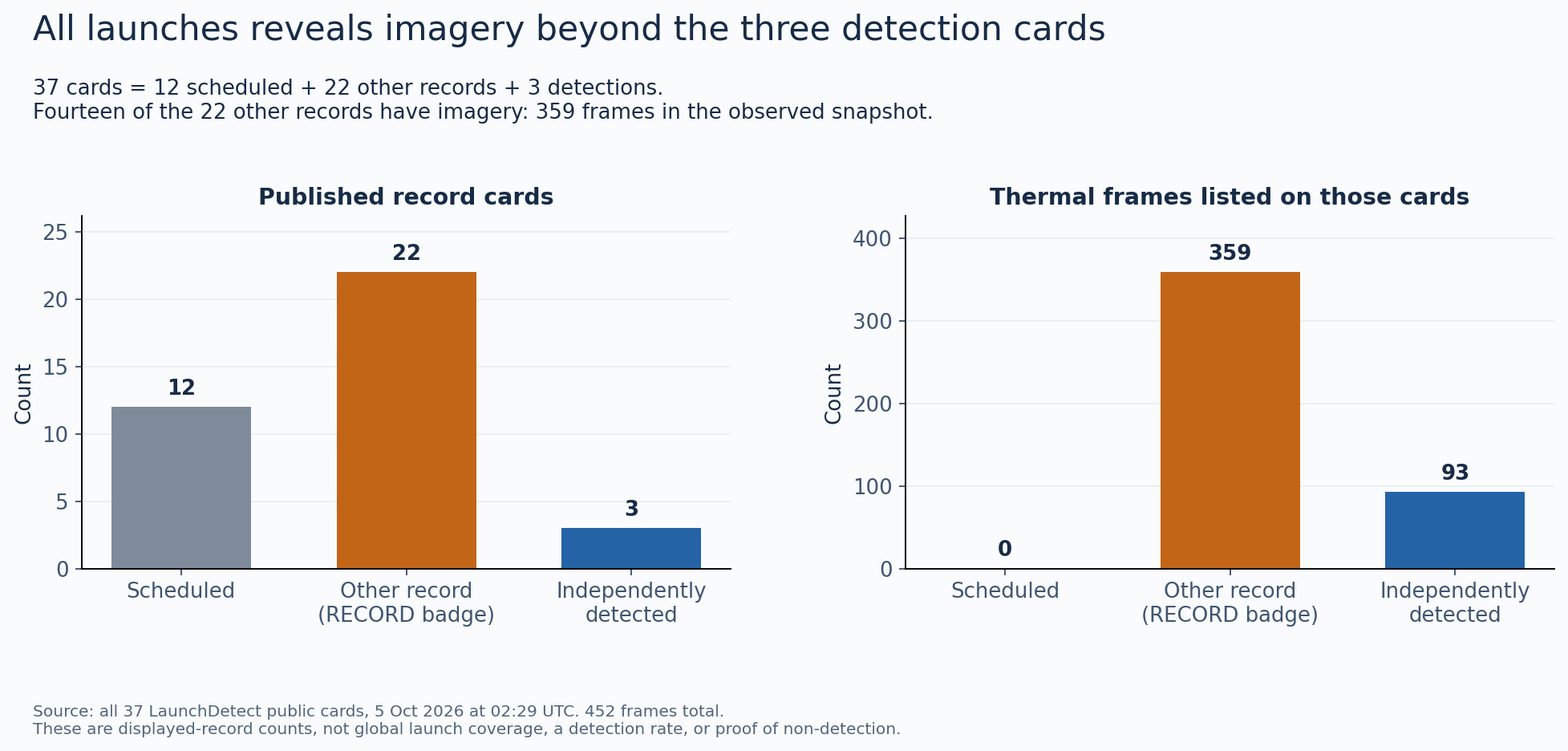
In that original snapshot, the 22 RECORD cards contained both image-bearing and zero-frame entries. Their 359 listed frames outnumbered the 93 listed on the three independently detected cards. This shows why choosing a view by its label can matter more than a broad search term when the immediate task is to find imagery.
The census records the badges and frame counts as displayed. It does not extend Transporter 18’s inspected detail message to every other RECORD page, and it does not verify every image or establish that the 452 listed frames are globally unique acquisitions. A zero on a card also does not establish that no underlying observation exists or that the public record will never change.
Check the time filters before changing the query
The time-filter tests provide another way to reconcile the 37-card population. With no search text, Live alone returned zero, Upcoming plus Live returned 12, Past plus Live returned 25, and all three returned 37. The first split is consistent with the 12 scheduled cards and the remaining 25 cards in this snapshot.
| Enabled filters | Returned cards |
|---|---|
| Live | 0 |
| Upcoming + Live | 12 |
| Past + Live | 25 |
| Upcoming + Live + Past | 37 |
Dividing three detected cards by either 37 total cards or 25 past/live cards would only produce a ratio of displayed categories. Neither denominator supplies a complete, independently labeled set of eligible launches with documented monitoring opportunities. It cannot establish detector recall, missed-launch rate or geographic coverage.
A short checklist for an apparently missing mission
For the next search, make the selection recipe explicit:
- Search text: use the mission name or a known site name, then check the full returned label.
- Evidence view: compare Detections with All launches if the goal is to find a record or imagery.
- Time filters: keep the relevant Past or Upcoming state enabled. Clear the search briefly if you need to inspect the wider population.
- Window and archive: note the dashboard’s displayed window and use the launch archive or a retained report link for older records.
- Confirmation: read the selected record’s own evidence statement before describing a result as detected.
Search switching, time-filter combinations, the Transporter 18 detail and its report link were checked here. This inspection did not test recovery of a mission outside the window. The browser’s globe did not initialize, so “Map view” filtering and globe interaction were also outside the test.
Downloads and inspection limits
Download the 37-card inventory and the filter and badge summary. The inventory preserves each displayed card string, badge and listed frame count, alongside the observation time. It is a dated audit of the interface, not a substitute for opening a mission’s record.
One interface detail matters when reproducing the count: during the one-result Transporter search, a secondary accessible status string still reported 37 matching events. The visible card list and primary 1-of-37 counter were used for this audit. That inconsistency means this test should not be presented as a completed accessibility audit of the dashboard.
The recovered record answers a concrete question: Transporter 18’s imagery was available in All launches at the time of inspection. Its confirmation status remained explicit. Recording the view, filters and report link makes that answer traceable even when the dashboard later changes.
Sources
- LaunchDetect public dashboard, signed-out card, search and filter inspection on 5 October 2026 UTC.
- Transporter 18 permanent report and dashboard record.
- Related reading: interpreting a missing detection. This case supplies a tested search workflow and complete card/frame reconciliation rather than inferring a cause for missing evidence.