Launch Watch · Dashboard evidence
Published
Three hours, 37 or 19 frames: auditing LaunchDetect’s thermal replays
Audit 93 published LaunchDetect frames across three launches. Compare actual replay spacing, inclusive counts and the nine frames without plotted score points.
USSF-385 and Starlink Group 15-27 each have 37 thermal frames in their published LaunchDetect replay. Gravity-1’s SpaceSail Polar Group #16 record has 19. Yet the first and last image timestamps span exactly three hours in all three records.
The difference becomes useful once the replay is treated as a timestamped inventory. A count of frames tells you how many images the published sequence contains; the time between those images tells you how much of the clock it spans. This audit joins all 93 frames to the score points shown beside them, using the public dashboard inspected on 5 October 2026 UTC, or 4 October in Hawaii.
Start with the endpoints, then count the gaps
The three permanent records are USSF-385, Starlink Group 15-27 and Gravity-1 / SpaceSail Polar Group #16. Reading every frame timestamp gives the following inventory. All times in the table are UTC; each pair of endpoints falls on the stated date.
| Record and image date | First–last image | Every consecutive gap | Frames | Plotted score points |
|---|---|---|---|---|
| USSF-385 · 26 September | 12:26:18–15:26:18 | 5 minutes | 37 | 34 |
| Starlink 15-27 · 20 September | 00:11:17–03:11:17 | 5 minutes | 37 | 34 |
| Gravity-1 · 15 September | 20:10:00–23:10:00 | 10 minutes | 19 | 16 |
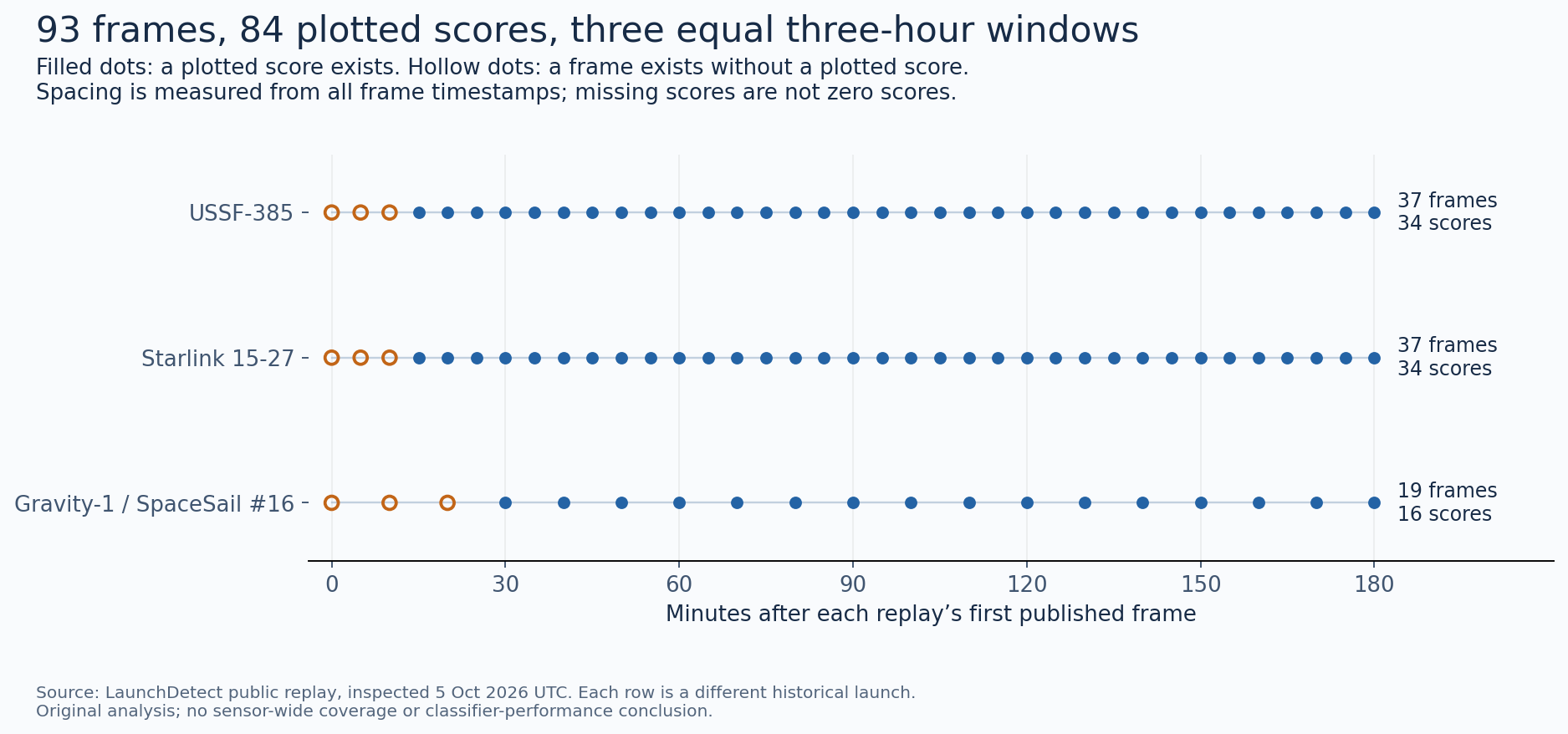
A sequence includes both endpoints. The 180-minute USSF-385 window contains 36 five-minute intervals, so it has 36 + 1 = 37 frames. Gravity-1 has 18 ten-minute intervals and therefore 19 frames. Checking every adjacent pair confirms those spacings throughout these particular sequences.
This is a measurement of the published replay files. It does not establish a satellite-wide acquisition cadence, how long the launch lasted, or the detector’s entire monitoring period. For a comparison of these records, “three-hour replay with five-minute spacing” conveys more than “37-frame replay.”
Keep an image and its plotted score as separate fields
The frame inventory contains nine timestamps with no corresponding plotted score point. They are the first three images in each replay:
| Record | Frame 1 UTC | Frame 2 UTC | Frame 3 UTC |
|---|---|---|---|
| USSF-385 · 26 September | 12:26:18 | 12:31:18 | 12:36:18 |
| Starlink 15-27 · 20 September | 00:11:17 | 00:16:17 | 00:21:17 |
| Gravity-1 · 15 September | 20:10:00 | 20:20:00 | 20:30:00 |
In the exported table, these score cells stay empty and the companion state field says “no plotted score.” A frame with a displayed 0% has a numeric zero and a different state. That distinction preserves what the interface actually exposes when the CSV is imported into a spreadsheet or joined to another table.
The inspected panels did not explain the nine absent points. The inventory cannot tell us whether their cause is initialization, a display choice or another processing step. It also cannot turn the score labels into temperature, calibrated probability, accuracy or alert speed. The useful result here is narrower and reproducible: 93 published images, 84 plotted score entries, and an explicit timestamp join between them.
Reconstruct a replay in the dashboard
For a repeatable inspection, open USSF-385 in the dashboard and keep the selected mission name visible while moving through the evidence.
- Open the thermal replay and move its frame control to the first image. Record the frame index and image timestamp, including the date and UTC designation.
- Move to the last image. Subtract the first timestamp from the last, then inspect the intervening timestamps for gaps. Dividing by an assumed cadence before checking the sequence can hide irregular spacing.
- Select a point in the score chart and compare its time with the selected image time. In this inspection, choosing the 13:56:18 point selected frame 19 of 37.
- Use “Jump to detection” to return to the recorded detection at 14:01:18, frame 20 of 37. This checks the connection between the chart, image navigation and detection marker without interpreting the score as a physical measurement.
- Repeat the inventory for another mission using its own timestamps. Do not align two records simply by frame number: frame 10 can represent a different elapsed time.
These replay controls and score selection were tested in the public, signed-out dashboard. The browser’s 3D globe did not initialize, so this walkthrough makes no claim about globe picking, camera behavior or the “Map view” filter.
Carry a small, explicit evidence table forward
Download the complete 93-frame CSV. Each row retains the event ID, case name, one-based frame index, acquisition timestamp, published image path, displayed score when present, score-entry state and browser observation time. The image paths are references to the public record; the download does not redistribute the underlying thermal images.
The observation time records when this inventory was inspected. The acquisition timestamp identifies the image. Keeping both lets a later reader distinguish a change in the public replay from a different image in the original sequence.
Before comparing two replays, check three things: the endpoint span, the distribution of adjacent time gaps and the join between images and plotted values. In this case, those checks resolve both apparent discrepancies: 37 and 19 frames cover the same three hours, and a valid image row can exist without a plotted score entry.
Sources and method
- LaunchDetect public records for USSF-385, Starlink Group 15-27 and Gravity-1 / SpaceSail Polar Group #16, inspected 5 October 2026.
- Method: inventory every published replay frame, match plotted score points by exact timestamp, subtract adjacent timestamps and preserve unmatched scores as missing. No pixel values, sensor calibration or detector-performance estimates enter the calculation.
- Related reading: keeping missing values distinct from measured zero. The present case adds the complete three-record frame-and-score reconciliation.