Launch Watch · launch_schedule_case
Published
Europa Clipper after Milton: a launch-date change in three NASA records
Trace Europa Clipper’s prior October 10 target, conditional October 14 plan and confirmed liftoff, while keeping source dates separate from event dates.
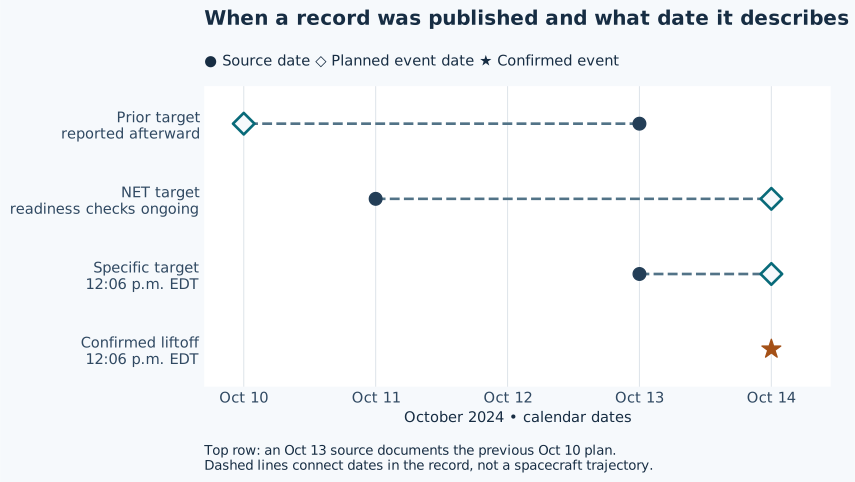
Europa Clipper’s October 2024 launch record becomes much clearer when every date has a job. October 10 was a prior target. October 11 was the date of an update naming a new earliest launch day. October 14 was the day NASA later confirmed liftoff.
The records below reconstruct that change without treating a planning statement as flight history. They also expose a small trap: the source that establishes the original October 10 target was published afterward.
Three publications, four useful entries
In its October 11 update, NASA said it and SpaceX were targeting no earlier than October 14 after Hurricane Milton, with readiness checkouts continuing. That is the dated announcement in this set that establishes the new earliest target. “No earlier than” leaves open a later launch.
The October 13 prelaunch article adds two facts: the previous October 10 plan had been delayed by Milton, and the October 14 opportunity was at 12:06 p.m. EDT. The October 14 release then confirms that Europa Clipper launched at 12:06 p.m. EDT aboard Falcon Heavy.
| Source publication | Date described | What this establishes | Record type |
|---|---|---|---|
| Oct 13, 2024 | Oct 10, 2024 | Previous launch plan, delayed by Hurricane Milton | Retrospective account of a plan |
| Oct 11, 2024 | No earlier than Oct 14 | New earliest target; checkouts continue | Conditional update |
| Oct 13, 2024 | Oct 14 at 12:06 p.m. EDT | Specific instantaneous opportunity | Prelaunch target |
| Oct 14, 2024 | Oct 14 at 12:06 p.m. EDT | Liftoff confirmed | Reported flight outcome |
Why the backward link matters
The first row points from an October 13 publication to an October 10 plan. That is valid evidence of the prior target, but it answers a narrower question than a saved October 10 schedule page would answer.
It tells us what the later NASA account says the plan had been. It does not show the exact text a reader encountered on October 10, every intervening edit, or the minute the decision to delay was made. A history assembled from present-day pages should preserve that distinction rather than quietly turn a retrospective statement into a contemporaneous snapshot.
Which record should a search for “when was October 14 announced?” return?
Within this selected set, return the October 11 update, with its “no earlier than” qualifier. Return the October 13 article for the specific 12:06 p.m. target and for its account of the earlier October 10 plan. Neither establishes the first internal decision time.
The practical fix is simple: store a source publication date beside the event date. Keep a third field for when you retrieved the source if you are building an archive. Those fields let a future reader distinguish the chronology of announcements from the chronology described inside them.
Four calendar days is the supported calculation
Subtract October 10 from October 14 on the calendar and the difference is four days. The result compares the previously planned launch date with the confirmed launch date. It is deliberately a date-level calculation.
Turning that number into “96 hours of delay” would add precision the retained original-target row does not have. It contains no October 10 target time. Nor does this subtraction measure how long hardware checkouts took, how long the launch site was unavailable or how much schedule margin remained.
A separate, useful check compares the October 13 target with the October 14 outcome: both records give 12:06 p.m. EDT for October 14. This establishes agreement at the minute precision reported in those sources. It does not establish an exact-second match.
Keep the qualifier until the outcome arrives
A useful archive entry would progress through the following labels: previous plan, no-earlier-than target, specific planned opportunity, confirmed liftoff. Each label communicates what the linked source can actually support.
The record here is intentionally partial. It does not identify the first stand-down announcement or preserve every revision. The cited NASA pages also have later update dates, so their original publication dates should not be mistaken for a complete page-version log.
When reading another delayed mission, ask two questions before copying a date: “When was this statement published?” and “Is the date inside it a plan or an outcome?” For Europa Clipper, those two questions yield a compact, defensible history: a prior October 10 target, a conditional October 14 target documented on October 11, and confirmed liftoff on October 14.