Launch Watch · Evidence study
Published
GOES-16 in 2019: an audited calibration review calendar
Audit 29 GOES-16 calibration-log rows from 2019, including a repeated gap notice, distinct same-day intervals and band-specific review points.
Two GOES-16 Band 2 images from opposite sides of 23 April 2019 may differ partly because a calibration correction occurred that day. A November gap can have a different explanation, and one missing-scan description appears twice in the log. Before interpreting image changes, it helps to put the operational record beside the observations.
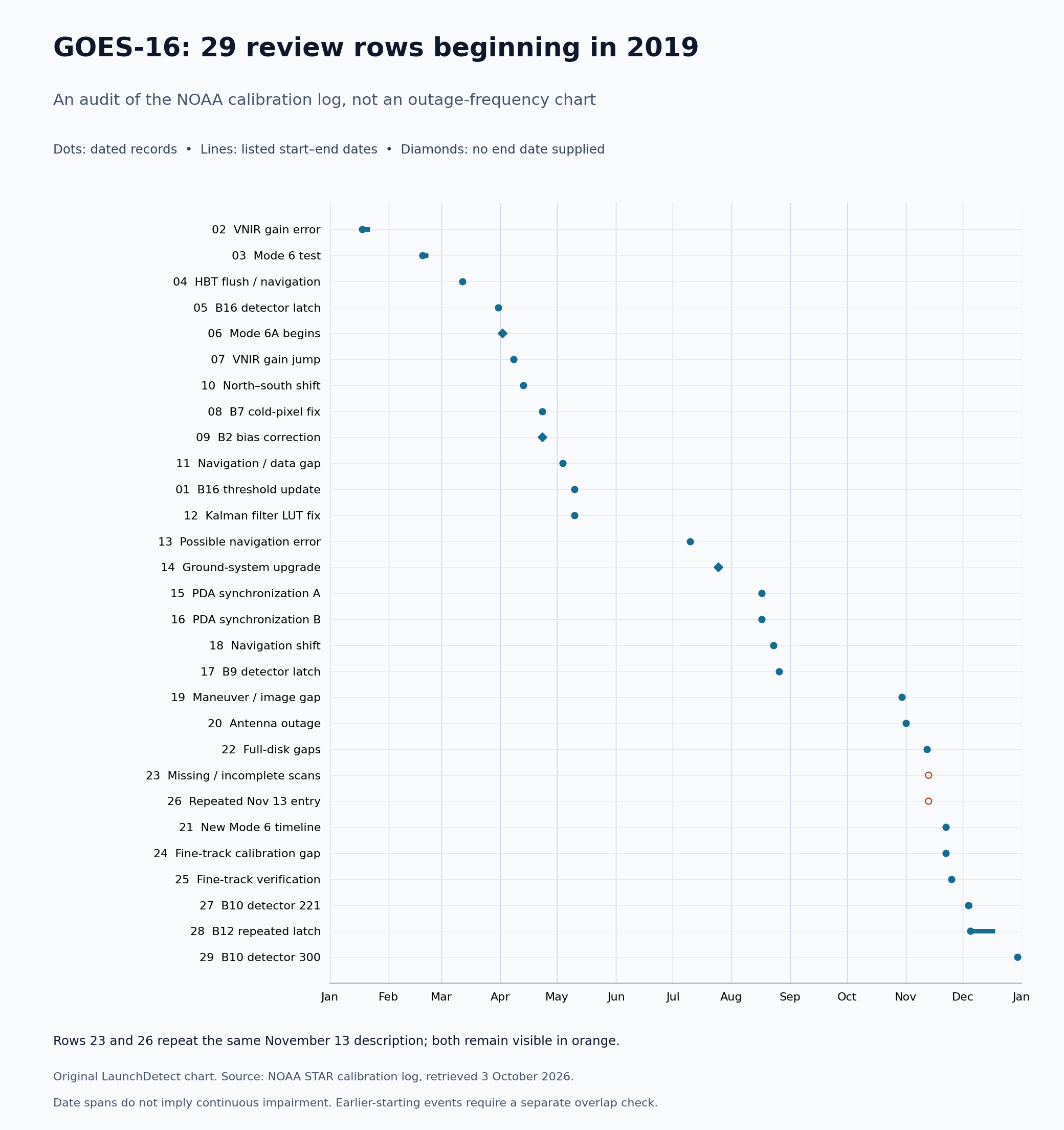
We audited the NOAA STAR GOES-16 calibration table and selected all 29 rows whose start date falls in 2019. The resulting calendar preserves duplicate descriptions, missing end dates and distinct same-day intervals. It is a review aid for historical imagery, not an automatic list of images to discard.
What changed after reviewing the rows
Keep both November 13 entries visible, but flag the repetition. Rows 23 and 26 have the same dates and the same description after whitespace normalization: a missing 18:10 full-disk image and incomplete 18:20 image. Their event titles differ. Removing the duplicate description leaves 28 date-and-description combinations, which still must not be called 28 independent incidents.
Keep the two August 17 entries separate. One synchronization interval runs from 06:00 to 16:50 UTC on August 17. The other runs from 21:20 that evening to 03:40 UTC on August 18. Deduplicating by date or event title alone would erase a distinct interval.
Do not stretch blank end dates into outages. Three selected rows have no end date: the April 2 Mode 6A transition, April 23 Band 2 correction and July 25 ground-system upgrade. They record changes with continuing relevance, but a blank cell does not establish continuous degraded operation.
April 23 contains two different review points
The log gives 11:00 UTC for a Band 2 calibration change with an approximately 6.2% reduction in radiance. It gives 20:15 UTC for a Band 7 resampler update addressing cold pixels around fire. Those are different bands, different interventions and different times.
For a before-and-after image comparison, that distinction changes the next step. A Band 2 brightness discontinuity calls for checking which calibration applies. A Band 7 fire-region artifact calls for checking the resampling correction and product quality information. Neither notice establishes that a particular pixel in your scene was affected; that requires the scene itself.
Use the calendar as a triage sequence
- Identify the product. Record satellite, band, scan sector, observation time and processing provenance before matching it to a notice.
- Match dates and explicit scope. A date match alone is too broad. Check the band, affected image format and the notice’s exact or approximate time.
- Separate change dates from impairment intervals. A calibration implementation, a missing scan and intermittent detector striping should not become interchangeable duration bars.
- Inspect the actual data. Check the relevant image and quality information, then document whether it is usable for your particular comparison.
Open the full 29-row review calendar
Times in the source descriptions are UTC where stated. “Around,” “may” and “about” are retained when the source is approximate or conditional. “No band stated” is a limit of that row, not a claim that every band was affected. Download the calendar as CSV.
| Row | Source date span | Explicit band or scope | Timing notes (UTC) | What to check |
|---|---|---|---|---|
| 02 | 2019-01-18 to 2019-01-22 | VNIR; B1/B2 stripes | Jan 18 15:00–Jan 22 16:00 | Incorrect gains; visible striping reported in Bands 1 and 2. |
| 03 | 2019-02-19 to 2019-02-22 | ABI mode; no band stated | Feb 19 15:00–Feb 22 15:00 | Three-day scan-mode test; not labeled as an outage. |
| 04 | 2019-03-12 | ABI; no band stated | Mar 12 23:05–23:15; navigation effects described separately | Ten-minute product outage; possible later navigation degradation and about three-hour anomaly. |
| 05 | 2019-03-31 | B16 | Mar 31 00:00–18:40 | Detector 211 space-look latch associated with striping. |
| 06 | 2019-04-02 (no end) | ABI mode; no band stated | Apr 2 16:00; no end date | New baseline scan mode; blank end does not mean continuous outage. |
| 07 | 2019-04-08 to 2019-04-09 | VNIR | Apr 8–9; exact times not stated | Gain jump above 10%; previous gains reapplied on Apr 9. |
| 10 | 2019-04-13 | VNIR strongest | Apr 13 23:00; 23:00–23:10 imagery may also be affected | Navigation shift; possible additional CONUS/MESO effects. |
| 08 | 2019-04-23 | B7 | Apr 23 20:15 | Resampler update addressing cold pixels around fire. |
| 09 | 2019-04-23 (no end) | B2 | Apr 23 11:00; no end date | Calibration change reduced reported B2 radiance by about 6.2%. |
| 11 | 2019-05-04 | IR noted after event | May 4 12:00–13:00; possible next-24-hour IR effects | Navigation anomaly plus gap; later IR errors may be slightly elevated. |
| 01 | 2019-05-10 | B16 | Time not stated | Lunar-rejection threshold updated to reduce striping potential. |
| 12 | 2019-05-10 | No band stated | May 10 15:29 | Temporary navigation-related control-table fix. |
| 13 | 2019-07-10 | ABI; no band stated | Jul 10 around 15:30 | Possible image navigation issue; time is approximate. |
| 14 | 2019-07-25 (no end) | Mixed-platform description | Jul 25; exact time not stated; no end date | Ground processing upgrade; description explicitly includes GOES-17 calibration. |
| 15 | 2019-08-17 | ABI; no band stated | Aug 17 06:00–16:50 | First stated synchronization interval. |
| 16 | 2019-08-17 to 2019-08-18 | ABI; no band stated | Aug 17 21:20–Aug 18 03:40 | Separate interval; do not collapse with the other Aug 17 row. |
| 18 | 2019-08-23 | All EW; VNIR NS | Aug 23 20:30; 20:30–20:40 may also be affected | East–west shift in all channels; north–south shift in VNIR. |
| 17 | 2019-08-26 to 2019-08-27 | B9 | Aug 26 22:30–Aug 27 12:26 | Striping followed detector 31 latch; manual reset released it. |
| 19 | 2019-10-30 | ABI; no band stated | Oct 30 22:50–23:00; later scans affected | Scheduled outage; following imagery may be incomplete or misnavigated. |
| 20 | 2019-11-01 | ABI; no band stated | Nov 1 13:10–13:40 | First good full-disk image stated as 13:40. |
| 22 | 2019-11-12 | ABI full disk | Nov 12 outage 18:25–18:50; missing scans 18:20, 18:30, 18:40 | Keep reported outage interval and scan labels separately; they differ. |
| 23 | 2019-11-13 | ABI full disk | Nov 13 missing 18:10; incomplete 18:20 | Same dates and description as row 26; preserved as a repeated entry. |
| 26 | 2019-11-13 | ABI full disk | Nov 13 missing 18:10; incomplete 18:20 | Same dates and description as row 23; event title differs. |
| 21 | 2019-11-22 | ABI mode; no band stated | Nov 22 16:10 | New operational scan timeline begins. |
| 24 | 2019-11-22 | ABI | Nov 22 16:00–16:10 | Ten-minute gap during Fine Track Error calibration. |
| 25 | 2019-11-25 | ABI full disk | Nov 25 missing 17:00 and 17:10 | Missing full-disk images; other formats may also be affected. |
| 27 | 2019-12-04 to 2019-12-06 | B10 | Dec 4 16:00; reset Dec 5; final update Dec 6 15:05 | Striping removed at reset; final resolution has later date. |
| 28 | 2019-12-05 to 2019-12-18 | B12 | Dec 5 16:10; temporary release 19:50; final update Dec 18 | Intermittent recurrence; full date interval is not continuous striping. |
| 29 | 2019-12-30 to 2019-12-31 | B10 | Dec 30 04:00–Dec 31 about 16:00 | End time explicitly approximate. |
Row IDs follow the source extraction order so duplicate titles cannot overwrite one another. The date-sorted display changes presentation order only. The source page is linked for the complete wording and surrounding entries.
A start-year filter misses carryover context
The 29-row selection deliberately asks which notices begin in 2019. A check for everything that could affect a 2019 scene needs an interval-overlap search as well. In the retained table, three earlier-starting rows have finite listed end dates in 2019: Channel 8 striping beginning 31 December 2018, Band 5 striping beginning in 2017, and the Band 7 cold-pixel issue also beginning in 2017.
The first extends through 31 January 2019 in the source dates. The latter two end on 24 June and 23 April 2019 respectively. Earlier rows with blank ends require additional interpretation rather than an automatic assumption that they remain active. One older source cell also contains concatenated material, another reason to preserve the original log instead of treating the extracted table as a flawless incident database.
Keep the remaining limits in view
NOAA describes this as a discretionary collection of events with known or potential Level 1b data-quality effects. It is not a complete availability record. Without a completeness guarantee and a suitable observation denominator, counts of its rows cannot establish a satellite failure rate.
The dates also have different meanings. December’s Band 12 row spans repeated striping and temporary release, not necessarily uninterrupted impairment. The November 12 description gives an outage interval and missing full-disk labels that do not line up exactly; both are preserved. The July 25 row sits in the GOES-16 table but its description explicitly discusses a GOES-17 calibration improvement, which should not be reassigned to GOES-16.
We have not retrieved affected calibrated scenes or measured a new pixel bias. The useful output is the audited calendar and its exceptions. Pair it with your exact imagery, record why a notice matters, and make the include-or-exclude decision at the product level.