Launch Watch · Spaceflight
Published
K2’s final campaign had three different data windows
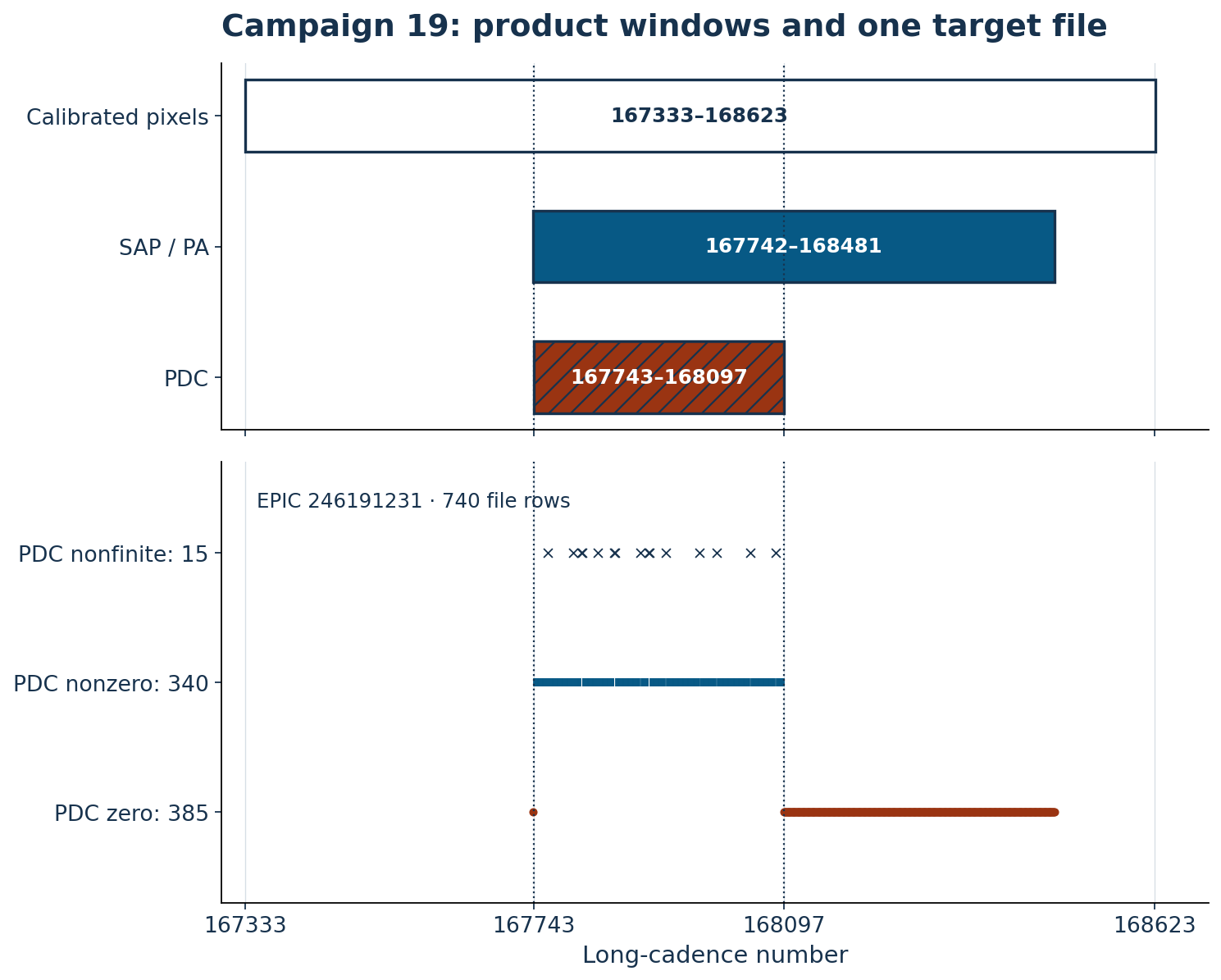
Match Campaign 19 calibrated pixels, SAP and PDC processing windows to a real 740-row target file, including 385 zero-filled corrected-flux rows outside the PDC interval.
K2 Campaign 19 offers almost a campaign of calibrated pixels, a shorter simple-aperture light curve and roughly a week of systematically corrected data. Choosing a file by the campaign name alone can hide those different windows.
One real example makes the difference concrete. The long-cadence file for EPIC 246191231 contains 740 table rows. Its corrected-flux column has 340 nonzero finite values, 385 exact zeros and 15 nonfinite values. Every zero lies outside the interval the release notes specify for PDC processing.
First choose the product and its documented interval
The permanent Campaign 19 release notes, revision 002, explain how changing spacecraft pointing led to different processing windows. The initial part was substantially off-nominal, the central part was comparatively stable, and the later part fluctuated.
| Product | Cadence range, inclusive | What the release notes say |
|---|---|---|
| Calibrated pixels | 167333–168623 | Nearly the entire campaign; not all pointing was suitable for photometry |
| Simple aperture: PA / SAP | 167742–168481 | Restricted by pointing-related processing selections |
| Systematics-corrected: PDC | 167743–168097 | Central interval of continuously stable pointing |
The central PDC interval contains 355 cadence indices when endpoints are counted inclusively. That number describes an index window. It does not promise 355 usable measurements for every target.
The target file demonstrates why row count is insufficient
| File check | Rows |
|---|---|
| All light-curve table rows | 740 |
| Finite SAP_FLUX values | 612 |
| Finite PDCSAP_FLUX values | 725 |
| Exact-zero PDCSAP_FLUX, all outside the PDC window | 385 |
| Nonzero finite PDCSAP_FLUX, all inside the PDC window | 340 |
| Nonfinite PDCSAP_FLUX | 15 |
| Nonzero PDC rows also having SAP_QUALITY = 0 | 334 |
A finite-only selection keeps 725 corrected-flux rows. It retains the 385 outside-window zeros as well as the 340 nonzero values within the documented interval. That would make the apparent coverage look much longer than the PDC processing window.
Even a quality-zero test cannot replace the window check. 139 of the outside-window zero rows also have SAP_QUALITY = 0 in this file. The cadence range and the product documentation therefore carry information that neither a finite-value test nor that quality value supplies by itself.
The 340 nonzero PDC values run from cadence 167743 through 168097. Of those, 334 also have SAP_QUALITY = 0. These counts describe this target and this retained file; they are not a certification that the remaining samples answer a particular science question.
Which product belongs in the next step?
For the pipeline’s corrected central interval, begin with the documented PDC window and inspect the target’s quality information. For work on the later variable-pointing interval, the notes direct attention to less-processed products and target-specific care rather than implying a complete PDC light curve exists there.
The release notes also caution that PDC processing over the short central span may suppress astrophysical variation on timescales of several days or longer. A clean-looking corrected curve is not enough evidence that such a signal was preserved.
This is a Campaign 19 product-selection example. It is not a universal rule to discard scientific zeros, and no transit, dimming event or planet is inferred. For the general distinction between missing data and measured zero, see the separate missing-versus-zero guide.
Reproduce the target audit
The 740-row CSV contains time, cadence, both flux fields, SAP_QUALITY and a flag for membership in the documented PDC window. Blank flux cells represent the source’s nonfinite values; numerical zeros remain zeros.
We read the original FITS file, checked its target, campaign, column formats and 740-row header, and independently verified its data checksum: DATASUM 1935824388. The retained source bytes were downloaded on October 5, 2026.
The time column is BKJD, meaning BJD in the TDB time scale minus 2454833. It is not UTC. The nonzero-PDC endpoints are about 7.2341 days apart; that is a span between sample centers, not accumulated exposure time. The limited parser used for this check is specific to this fixed-width file and is not offered as a general FITS reader.
Sources and acknowledgment
The numerical audit uses the MAST K2 target file linked above. Processing interpretation comes from KSCI-19145-002, especially sections 2.1.2 and 3.1–3.2. Data reuse follows the MAST data-use policy; the mission acknowledgment guidance supplies the following credit.
This paper includes data collected by the Kepler mission and obtained from the MAST data archive at the Space Telescope Science Institute (STScI). Funding to US Institutions for the Kepler mission was provided by the NASA Science Mission Directorate. STScI is operated by the Association of Universities for Research in Astronomy, Inc., under NASA contract NAS5–26555.
Original diagram and file audit: LaunchDetect. No NASA or STScI endorsement is implied.