Launch Watch · Current evidence
Correction prepared .
Published
SDA’s fourth transport plane: the 21-satellite count, with its limits
A six-row evidence ledger tests what SDA’s planned 21-satellite launch would add to its 126-spacecraft Transport Layer and what remains unverified.
SpaceX’s next SDA mission plans to add 21 data-transport satellites in a fourth orbital plane. How much of the Transport Layer would that represent? Using SDA’s last count in the primary release examined here, the arithmetic is 63 + 21 = 84, or two-thirds of a planned 126-spacecraft complement. Every part of that sentence needs its state attached: 63 is a historical report, 21 is a manifest, and 84 is a conditional subtotal.
The useful question for a space-domain-awareness record is what evidence changes each state. A successful flight could advance the delivered count. A separate report would be needed to establish how many spacecraft have completed checkout or joined the operating network. This article builds a six-row count ledger for this particular mission so that those updates can be made without turning a spacecraft fraction into a capability claim.
The six-row count ledger
SDA’s 16 July release reported 63 Tranche 1 spacecraft on orbit after that day’s transport launch. The same release described the eventual design as 126 transport spacecraft, 28 tracking spacecraft, and four additional demonstrators. Those are different populations, and the July statement is not a new October inventory.
| Quantity | Spacecraft | Evidence state |
|---|---|---|
| July transport baseline | 63 | Reported on orbit by SDA on 16 July; historical baseline |
| Next transport manifest | 21 | Still planned by SpaceX as of 5 October, 18:10 UTC; current target 6 October |
| Conditional transport subtotal | 84 | 63 + 21 only if the planned delivery succeeds; not a current fleet count |
| Transport Layer complement | 126 | Planned design population |
| Tracking Layer complement | 28 | Separate planned design population |
| Additional demonstrators | 4 | Listed in addition to 126 transport + 28 tracking |
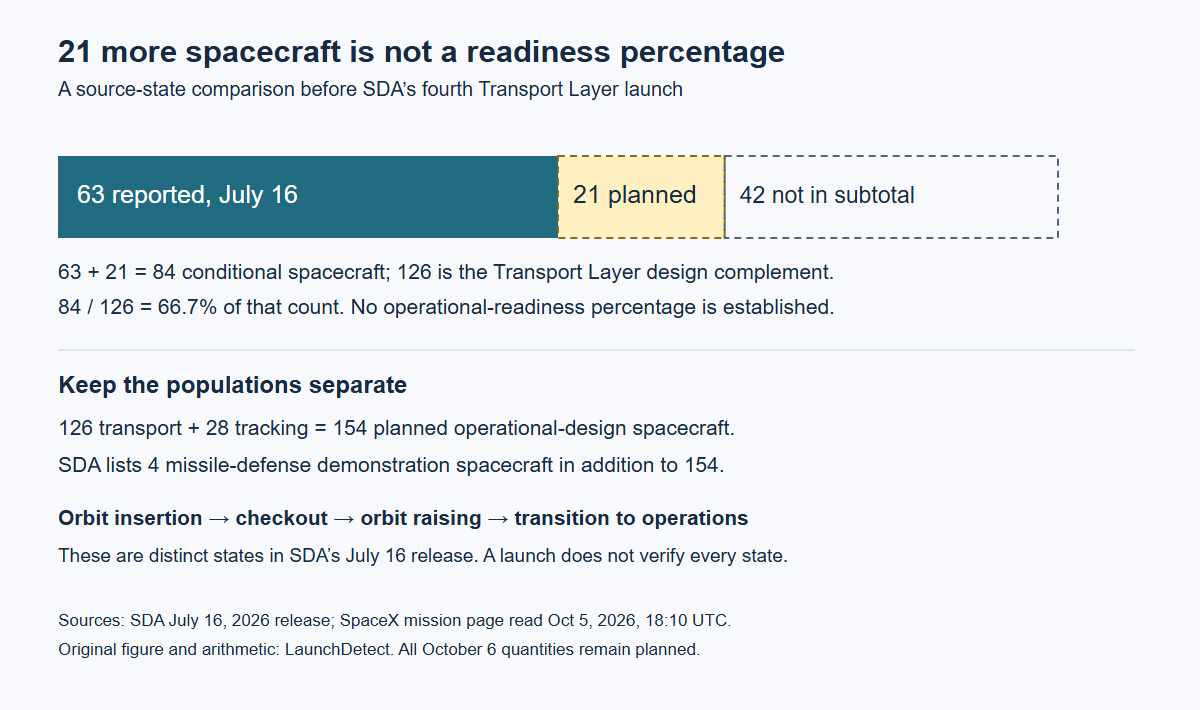
The denominator answers the question. For the transport-only question, 84 / 126 = 66.7%. Add the tracking population and the planned operational-design count becomes 126 + 28 = 154. Include the four demonstrators and all listed design spacecraft sum to 158. Dividing 84 by either 154 or 158 would mix a transport-only numerator with a broader population. Those ratios answer a different question and would obscure progress within the transport layer.
The unfilled 42 in the chart is simply 126 − 84. It does not identify 42 particular spacecraft, assign them to future flights, or establish their manufacturing status. Likewise, this ledger cannot establish whether the historical 63 remain healthy, are all at their intended altitude, or are connected to one another. It preserves what the sources actually counted.
Where a capability percentage breaks
A count fraction treats every included spacecraft as one unit. An operational fraction would require a definition of usable capability and evidence about the relevant spacecraft, links and ground functions. This public manifest does not provide those measurements. Even a confirmed 84 delivered spacecraft would not, on its own, establish 66.7% geographic coverage, throughput, availability or readiness.
The fourth-plane label adds a useful deployment fact to the manifest, but it does not supply a public coverage map. Converting that label into continuous service would require more information than a count and an orbital-plane ordinal. For a public launch record, the defensible update is therefore specific: retain the planned number, then replace its state only when a source reports what happened.
Which evidence would change the record?
SDA described the July spacecraft progressing from insertion orbit through checkout and orbit raising to approximately 1,000 kilometres before operations. That sequence gives this mission’s ledger a practical set of evidence questions. The table below is our reporting test, not a claim that each stage has already been completed or that every detail must be public.
| New evidence | Update it could support | Still outside that evidence |
|---|---|---|
| Operator confirms liftoff | Launch attempt occurred at a reported time | All 21 payloads separated successfully |
| Operator or SDA reports payload delivery | Specific delivered quantity and outcome, as stated | Health, checkout completion and network acceptance |
| Dated orbital or mission-status report | The orbital state or maneuver progress actually documented | Full functionality inferred from altitude alone |
| SDA commissioning or acceptance report | The operational status and scope explicitly reported | An unreported global coverage or capacity percentage |
This avoids a common database problem: a single “successful” label absorbing several different outcomes. Keep the quantity, population, event time, source-check time and status together. If a postflight release confirms delivery but says checkout is continuing, the record can show both without contradiction. If an update reports fewer or different spacecraft, change the source-backed rows rather than preserving the expected subtotal.
The public flight table stops before a payload time
At our 5 October source recheck, the public table still contained 11 approximate entries, ending with first-stage landing at T+7 minutes 32 seconds. It still provided no spacecraft-deployment timestamp. That is a limit of this public table, not evidence that deployment has failed or that a particular deployment time is secret.
The table’s landing event cannot be used as the time all 21 satellites entered their next state. For the general distinction between vehicle and payload events, see our existing launch-milestone guide. Here the mission-specific finding is narrower: the inspected timeline does not furnish a timed payload event with which to update the count ledger.
Inspect the 11 source-table entries
| Elapsed after liftoff | Planned event |
|---|---|
| 00:01:04 | Maximum dynamic pressure |
| 00:02:14 | First-stage main-engine cutoff |
| 00:02:17 | Stage separation |
| 00:02:25 | Second-stage engine start |
| 00:02:31 | Boostback burn begins |
| 00:03:01 | Fairing separation |
| 00:03:24 | Boostback burn ends |
| 00:06:08 | First-stage entry burn begins |
| 00:06:21 | First-stage entry burn ends |
| 00:07:14 | First-stage landing burn begins |
| 00:07:32 | First stage lands at LZ-4 |
Download the complete planned timeline CSV. Absolute clock conversions in the CSV use the 5 October recheck’s prose target of 6 October at 08:17 UTC, not the header-window start, and must be regenerated if that target changes.
Method and limits
We placed the primary-source quantities into a six-row CSV, retained each source date and state, and calculated the conditional sum and denominators directly. We separately parsed the 11 elapsed times, confirmed their order, and checked the latest listed event. The chart is an original rendering of those factual values, with different fill treatments for the historical report and planned addition. Download the count-and-state CSV.
The analysis does not add a fresh orbital census, telemetry, a service test or a satellite-health assessment. Its arithmetic is deliberately conditional. Before any postflight revision, the operator and SDA sources must be reread; a changed target alters the time conversions, while a reported outcome may alter the count or its state.
The immediate result is a cleaner watch question: does the next primary update confirm the planned delivery, and what does it actually say about the spacecraft afterward? Keeping those statements separate makes the launch useful evidence without making it carry conclusions the source has not established.
Sources and current-interest context
- SpaceX: SDA’s Fourth Tranche 1 Mission, live page originally checked 4 October 2026 at 20:04 UTC; captured again 5 October at 18:10 UTC and rechecked 5 October 2026, 19:10 UTC.
- SDA: third Tranche 1 launch and architecture counts, 16 July 2026.
- Air & Space Forces coverage and DefenseScoop coverage, both dated 2 October, supplied current editorial context. Two articles found in a bounded search are an attention proxy, not measured clicks, search volume or a popularity ranking.