Launch Watch · Dashboard evidence
Published
Read USSF-385’s 178 satellite crossings as a dated model snapshot
Audit USSF-385’s 178 historical crossing entries. Read the check time, sort the list and keep expired model labels separate from collision-risk conclusions.
USSF-385’s Satellite Crossings panel listed 178 entries when inspected on 5 October 2026 UTC, still 4 October in Hawaii. The panel’s own check was dated 26 September. All 178 listed times were also on 26 September, so opening this record in October exposed a historical model result.
The USSF-385 dashboard record explicitly cautions that listed satellites may cross modeled launch areas without a collision being expected. A useful audit therefore starts with the check timestamp, the complete row list and the displayed model state. The count alone cannot supply a collision probability.
Put each clock beside its meaning
| Field | Timestamp | What this audit uses it for |
|---|---|---|
| Browser inspection | 5 Oct 2026, 02:28:31 | When this panel was observed |
| Satellite check | 26 Sep 2026, 14:19:18.917 | Date attached to the crossing computation |
| Earliest listed crossing | 26 Sep 2026, 14:20:18.917 | Minimum across all 178 entries |
| Latest listed crossing | 26 Sep 2026, 16:09:18.917 | Maximum across all 178 entries |
| Record evidence update | 3 Oct 2026, 14:19:32 | Separate evidence-update field |
The October evidence update does not replace the September check time. Keeping both prevents a recently updated record from making an older crossing list appear newly calculated. The permanent USSF-385 launch report supplies a durable record identity alongside the dashboard view; the copied audit data preserves the inspected list.
Subtracting the earliest listed crossing from the latest gives 109 minutes. Relative to the check time, the entries range from 1 to 110 minutes later. These are measured bounds of the returned list. They do not establish the full interval searched by the model: a search could extend beyond its first or last matching entry.
Sort a copy before choosing the first crossing
The displayed list was not chronological. Its first entry, HONGYUN 1, had a time of 15:00:18.917 UTC. STARLINK-31662 appeared at row 90 with a time of 14:20:18.917 UTC, 40 minutes earlier. Taking the first displayed row as the earliest would therefore change the result.
The 178-row audit CSV preserves original display order and adds the check timestamp, event identifier and minutes after the check. Copy the table, parse the full UTC timestamps, then sort that copy by crossing time. Retaining display order makes it possible to reconstruct the source presentation after sorting. The list contains 178 distinct displayed names; that is a name-string check, rather than independent verification of catalog identities.
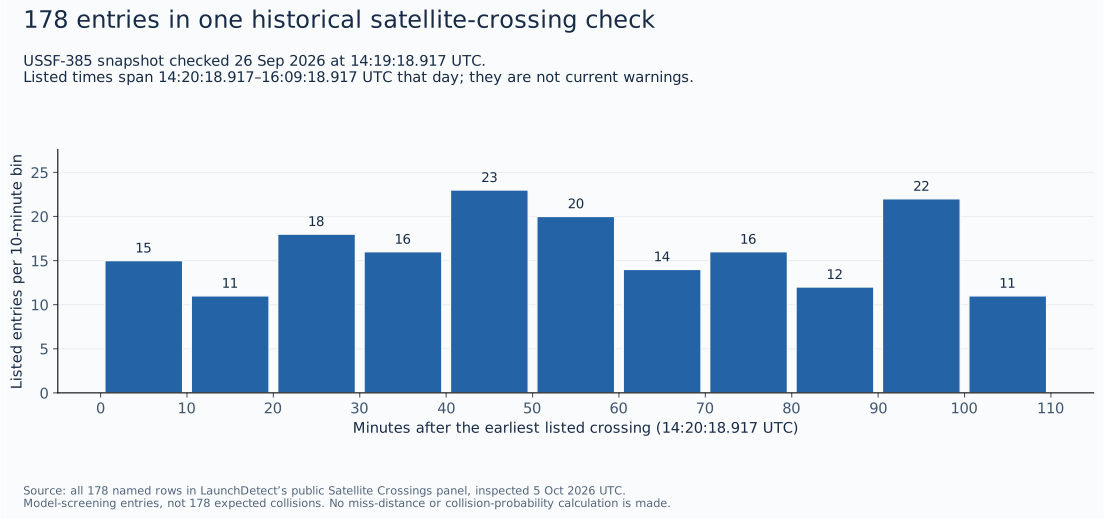
For a text check of the graphic, successive bins beginning 0, 10, 20, 30, 40, 50, 60, 70, 80, 90 and 100 minutes after the earliest entry contain 15, 11, 18, 16, 23, 20, 14, 16, 12, 22 and 11 rows. Those counts sum to 178.
Read expired as a displayed model state
The Predicted rocket parts section showed four categories. The table preserves its status words and published altitudes as model labels. These fields do not provide independent observations of part location, recovery, reentry or payload health.
| Category | Displayed state and descriptor | Published altitude |
|---|---|---|
| booster | expired · recovered | 93 km |
| fairing × 2 | expired · recovered | 157 km |
| upper stage | expired · deorbit burn | 425 km |
| payload | expired · orbital | 425 km |
The browser also showed No position beside the satellite rows. Its Cesium/WebGL globe failed to initialize, while the textual list remained available. This inspection therefore verifies the text and timestamps, without establishing globe positions or diagnosing a service-wide orbital-data failure.
An empty dated list needs the same treatment
Two other inspected records listed no crossings: Starlink Group 15-27, checked 24 September at 18:19:18.801 UTC, and Gravity-1 / SpaceSail Polar Group #16, checked 22 September at 22:19:18.833 UTC. Both checks were in 2026. These are zero-row results attached to specific checks; they do not establish current orbital safety or make those missions safer than USSF-385.
NASA’s Conjunction Assessment Risk Analysis overview separates event prediction, close-approach risk assessment and mitigation. That distinction is useful here, without asserting that this dashboard implements NASA’s process. A list of modeled crossings supplies neither an observed collision count nor a completed risk assessment.
Keep a reproducible handoff
- Select USSF-385, open Satellite Crossings and record Last checked before reading the entries.
- Copy the entire list, retain display order and inspect Predicted rocket parts. Keep expired labels and missing positions visible in your notes.
- Hand over the event identifier, check timestamp and full row list together. Add your inspection time and any separate update field so another reader can locate the same evidence state.
For this case, that handoff contains event ld-dbd773dda2e52ceb, the 26 September 14:19:18.917 UTC check and all 178 historical entries. It supports a traceable timing-and-state audit. Any subsequent operational assessment requires its own suitable data and method.